岷
Character Story & Explanation
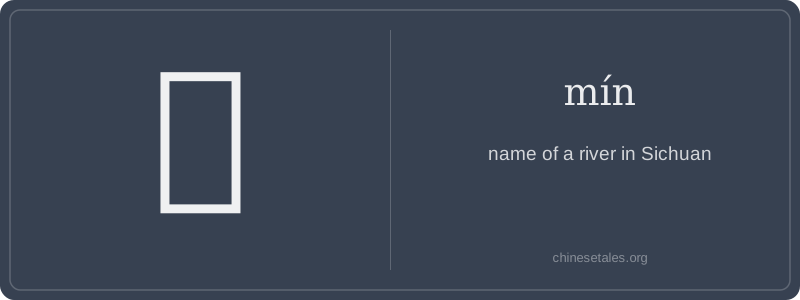
The earliest form of 岷 appears in seal script (around 3rd century BCE), where it combines 山 (shān, 'mountain') on the left and 旻 (mín, an ancient character meaning 'vast sky' or 'autumn sky') on the right. The original oracle bone inscriptions don’t contain 岷—it emerged later as a specific toponymic compound. Visually, the left side is clearly 山: three upward strokes representing mountain peaks. The right side, 旻, evolved from a pictograph of clouds beneath heaven (宀) — suggesting high-altitude, mist-shrouded terrain. Over time, 旻 simplified into the current four-stroke right component, retaining its phonetic role while anchoring the character firmly in landscape.
This visual pairing wasn’t accidental: the Min Mountains (岷山) straddle the eastern edge of the Tibetan Plateau, where towering peaks pierce cloud cover year-round. Classical texts like the *Shu Jing* (Book of Documents) mention ‘the waters of 岷’ as the sacred source of the Yangtze, reinforcing its mythic status as a hydrological origin point. Even today, locals refer to the upper reaches as ‘the headwaters of 岷’, treating the character itself as a geographic anchor—not just a name, but a cartographic signature etched in ink and altitude.
Imagine standing on a mist-wrapped cliff in western Sichuan, watching the Min River carve its way through deep gorges—its turquoise water roaring past ancient Taoist temples and bamboo forests. This isn’t just any river: in Chinese, 岷 (mín) *is* that river—the Min River, one of the Yangtze’s longest tributaries and the lifeblood of Chengdu Plain. It’s not a generic word for 'river' like 河 (hé) or 江 (jiāng); it’s a proper noun, like 'Nile' or 'Mississippi'—always capitalized in spirit, never pluralized, never used as a verb.
Grammatically, 岷 appears almost exclusively in geographical names and formal contexts: you’ll see it in place names (岷山 Mín Shān), historical texts, or news reports about hydropower or ecological protection. You won’t say *‘I drink from the 岷’*—that would sound as odd as saying *‘I drink from the Mississippi’*. Instead, it’s embedded in compounds like 岷江 (Mín Jiāng, 'Min River') or 岷山 (Mín Shān, 'Min Mountains'). Learners often mistakenly treat it as a standalone noun meaning 'mountain' or 'water', but it carries no independent meaning outside its toponymic identity.
Culturally, 岷 evokes layers of Daoist reverence, Tibetan borderland history, and Sichuan’s agricultural soul—it’s where Du Fu wrote exile poems and where pandas still roam wild slopes. A common mistake? Confusing it with 闽 (mǐn, Fujian Province) or 民 (mín, 'people')—homophones that share no semantic ground. Remember: 岷 is geography, not governance or ethnicity—and it always wears its 山 radical like a crown of snow-capped peaks.