岵
Character Story & Explanation
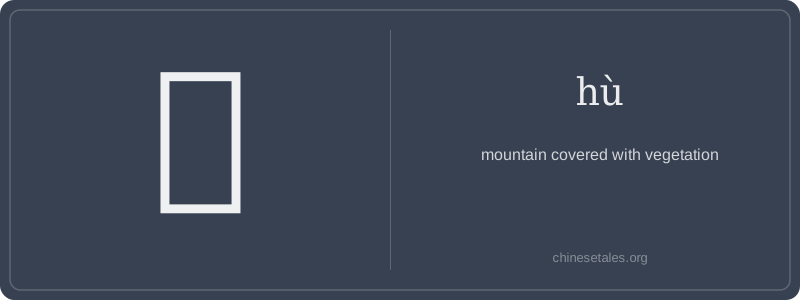
The earliest form of 岵 appears in bronze inscriptions as a clear pictograph: a simplified mountain (three jagged peaks) topped by a stylized cluster of plants—originally drawn as three upward-curving strokes representing leaves or grasses sprouting from the summit. Over centuries, the mountain base solidified into the modern 山 radical (three strokes: 丨 丨), while the vegetation element evolved from wavy lines into the elegant, flowing 乎 (hū) on the right—a phonetic component that also subtly echoes rising breath or mist among trees.
This visual logic held firm: 山 + 乎 = mountain *imbued with life*. By the Han dynasty, 岵 was already used in texts like the *Shuōwén Jiězì* to describe ‘mountains thick with trees and herbs’—a definition unchanged for 2,000 years. Unlike many characters that shifted meaning, 岵 stayed remarkably faithful to its origin: not a metaphor, not an abstraction, but a precise, quiet snapshot of ecology captured in eight strokes.
At its heart, 岵 (hù) evokes a very specific kind of mountain—not barren or jagged, but lush, breathing, and quietly alive with vegetation. It’s not just 'green mountain'; it’s the *feeling* of dense foliage clinging to slopes, mist weaving through ancient pines, the hush of deep forest cover. This isn’t abstract: in classical poetry and geographical texts, 岵 carries a gentle, almost reverent tone—suggesting harmony between terrain and life, not conquest or grandeur.
Grammatically, 岵 is almost exclusively used in compound nouns or proper names—not as a standalone verb or adjective. You’ll rarely see it alone in modern speech; instead, it appears in poetic place names (like 岵山, Hù Shān) or literary descriptions where precision matters. Learners often mistakenly try to use it like 山 (shān) — saying *'hù yǒu yī zuò shān'* — but that’s redundant and unnatural. Think of 岵 as a 'flavor word': it adds botanical texture only when paired, never solo.
Culturally, 岵 reflects the Chinese aesthetic of *shèngjìng* (sacred stillness)—mountains aren’t just landforms, but living repositories of qi and biodiversity. Its absence from the HSK list isn’t about rarity, but about register: it’s too literary for daily chat, yet deeply embedded in China’s geomantic and poetic imagination. A common mistake? Confusing it with 玉 (yù, 'jade') due to the similar right-side component—but 玉 has no 山 radical and zero connection to terrain.