岱
Character Story & Explanation
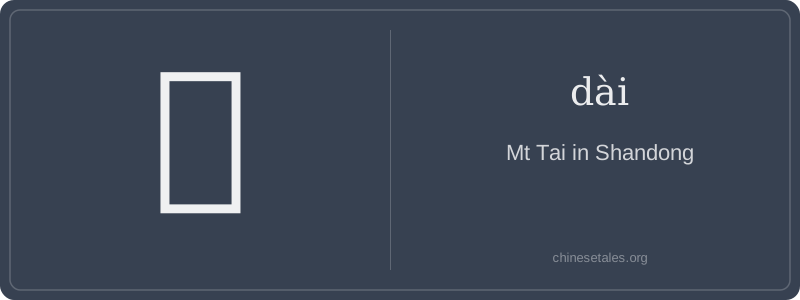
The earliest form of 岱 appears in bronze inscriptions from the Zhou dynasty as a compound pictograph: 山 (mountain) fused with 代 (a simplified depiction of a hand holding a ceremonial staff over a kneeling figure, later stylized into 代). This wasn’t random—it encoded the idea of ‘the mountain where the Son of Heaven performs rites on behalf of generations’. Over centuries, the right side streamlined from complex ritual imagery to the modern 代 (dài), while the left 山 remained unmistakably mountainous—eight clean strokes balancing weight and grace.
By the Han dynasty, 岱 was firmly established as the honorific title for Mount Tai in texts like the Book of Documents (《尚书》), which calls it 岱宗—the ‘Chief of the Peaks’, signifying its primacy among sacred mountains. Its visual structure reinforces this hierarchy: 山 anchors the character literally and metaphorically, while 代 suggests continuity, succession, and divine delegation. Poets like Du Fu wrote ‘岱宗夫如何?’ (‘How majestic is the Chief of the Peaks?’)—using 岱 not just as a name, but as a synecdoche for cosmic order itself.
岱 (dài) is not just a name—it’s a mountain breathing with history. It refers exclusively to Mount Tai (泰山), the easternmost and most revered of China’s Five Great Mountains, located in Shandong. In Chinese, 岱 carries solemn, poetic weight—never used for any other peak, and never as a generic word for 'mountain' (that’s 山). You’ll almost always see it paired: 泰岱, 岱宗, or 岱岳—like sacred titles rather than place names. Think of it as ‘Mount Tai’ wearing ceremonial robes.
Grammatically, 岱 functions only as a proper noun component—it doesn’t stand alone in speech or writing. You won’t say *‘I climbed 岱’*; instead, you say 泰山 or 泰岱. Learners sometimes try to use it like a common noun ('a lofty 岱'), but that’s unnatural—even native speakers avoid it outside classical or literary contexts. Its usage is tightly bound to reverence: poets invoke 岱宗 (‘Chief of the Peaks’) when praising imperial legitimacy; scholars write 岱顶 (Dàidǐng, ‘summit of Mount Tai’) to evoke spiritual ascent.
Culturally, 岱 embodies Confucian cosmology—the east symbolizes birth, renewal, and imperial mandate. Emperors performed Fengshan sacrifices here to report success to Heaven. A common learner mistake? Pronouncing it dài but writing it as 代 (dài, 'generation') or 戴 (dài, 'to wear')—homophones with wildly different meanings. Remember: if it has 山 on the left, it’s about geography and awe—not time or headgear.