岬
Character Story & Explanation
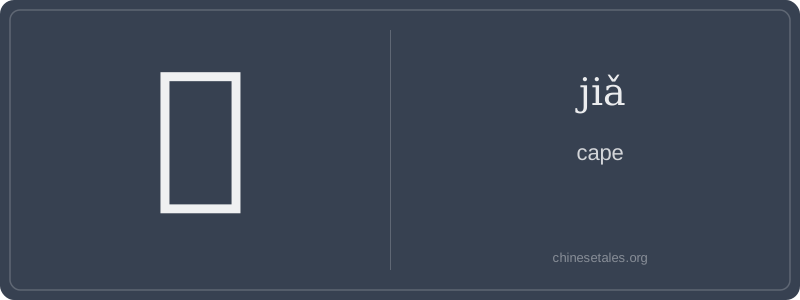
岾 has no oracle bone or bronze script form — it’s a relatively late creation, first appearing in seal script (c. 3rd century BCE) as a deliberate compound: 山 on the left, 甲 on the right. Early scribes didn’t draw a coastline; they *constructed* meaning. The 山 radical was carved with three distinct peaks (modern simplification reduced them to the standard 山 shape), while 甲 was rendered with its full 'box-with-cross' structure — symbolizing something solid, shield-like, and topographically dominant. Stroke by stroke, it evolved from a balanced, slightly ornate seal-script glyph into the clean, compact 8-stroke form we use today: 山 (3 strokes) + 甲 (5 strokes), with the horizontal stroke of 甲 neatly aligning with the mountain’s central ridge.
The meaning crystallized during the Han dynasty, when geographical writing demanded precise terms for coastal features. Before 岬, writers used descriptive phrases like '山入海處' ('place where mountain enters sea'). 岬 offered elegance and economy — one character carrying both elevation and projection. Though rare in classical Chinese poetry, it appears in Tang-era maritime records and Song dynasty coastal defense manuals, always paired with names: e.g., '成山岬' (Chéngshān Jiǎ), anchoring real geography to linguistic precision. Its visual logic is perfect: a mountain wearing armor, standing guard at the sea’s edge.
Think of 岬 (jiǎ) as Chinese cartography’s quiet poet: it doesn’t mean just any bit of land jutting into water — it’s specifically a *steep, rocky, prominent cape*, often windswept and isolated. The radical 山 (shān, 'mountain') anchors it firmly in terrain vocabulary, while the right side 甲 (jiǎ, 'first; armor; shell') isn’t arbitrary — it evokes both protective solidity and topographic prominence, like a mountain’s armored shoulder thrusting boldly into the sea. This isn’t a casual word: you won’t hear it in everyday speech ('coast' is 海岸 hǎi'àn), but it appears with precision in geography textbooks, nautical charts, and literary descriptions of dramatic seascapes.
Grammatically, 岬 functions almost exclusively as a noun — never a verb or adjective — and nearly always appears in compound nouns (e.g., 日本最南端の佐多岬 Sata-misaki). It rarely stands alone, unlike English 'cape'; saying just '岬' sounds abrupt, like naming a landmark without context. Learners sometimes misread it as 甲 (jiǎ) alone and assume it means 'first' or 'armor', missing the mountain radical entirely — a classic 'radical blindness' trap that erases the landscape from the word.
Culturally, 岬 carries a subtle sense of solitude and grandeur. In Japanese usage (where it’s far more common than in modern Chinese), places like 舞子岬 (Maiko Misaki) evoke melancholy beauty and maritime tradition — a nuance that bleeds into Chinese academic and poetic usage. Interestingly, while not in the HSK, it appears in Chinese translations of foreign geography texts and coastal conservation reports, making it a 'quiet specialist' — unassuming in form, indispensable in precision.