岫
Character Story & Explanation
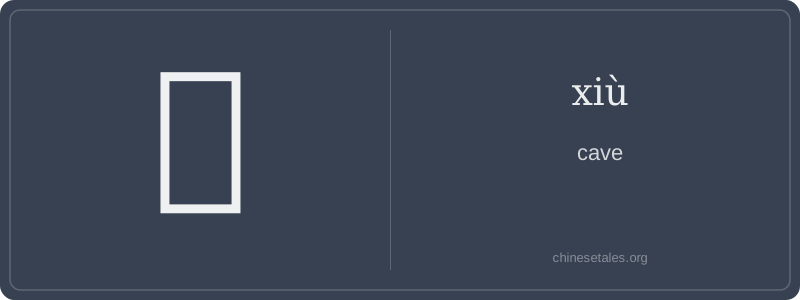
The earliest form of 岫 appears in seal script (around 200 BCE), where it clearly shows 山 (mountain) on the left and 又 (yòu, 'again/hand') on the right — but this 又 is actually a phonetic loan, not a semantic clue. Over time, 又 evolved into the simplified right-hand component you see today (a bent stroke + dot), losing its original hand-like shape. The left radical 山 remains unmistakable — eight strokes total: three short verticals for mountain peaks, then five strokes forming the right-side ‘cave’-suggesting silhouette. Interestingly, there’s no oracle bone version — 岫 emerged later, likely coined during the Warring States period specifically to capture the aesthetic idea of a recessed, sheltered mountain hollow.
By the Han dynasty, 岫 was already entrenched in literary usage — Sima Xiangru’s rhapsodies describe 'yun xiu' (cloud-wrapped caves), and Li Bai wrote of 'qing xiù' (azure caves) where immortals dwell. Its visual form reinforces meaning: the 山 radical grounds it in geography, while the right side’s curved, enclosing shape subtly suggests an inward curve — the mouth of a cave receding into stone. Unlike pictographs that show what’s *inside* a cave, 岫 shows what the cave *does* to the mountain: it creates a graceful indentation, a breathing space in the rock.
At first glance, 岫 (xiù) looks like a simple mountain-plus-something character — and it is! Its core meaning is 'cave' or 'rocky hollow in a mountain', but not just any cave: it evokes the quiet, mist-shrouded grottos of classical Chinese landscape poetry — places where recluses meditated and poets found inspiration. It’s not a functional word like 洞 (dòng, 'hole/cave') used for subway tunnels or mouse holes; 岫 carries literary weight, almost always appearing in poetic or descriptive contexts, never in daily speech or modern administrative language.
Grammatically, 岫 is almost never used alone. You’ll find it only in compound words — usually as the second character, like in 峰岫 (fēng xiù, 'peaks and caves'), or in proper nouns like the famous place name 岫岩 (Xiùyán), a county in Liaoning famed for its jade and limestone karst formations. Learners sometimes mistakenly treat it as a free-standing noun ('a cave!'), but it simply doesn’t work that way — trying to say *‘wǒ kànjiàn yī ge xiù’* sounds jarringly unnatural, like saying 'I saw a glade' in English without context. It’s a poetic fossil — grammatically bound, semantically elevated.
Culturally, 岫 appears in Du Fu’s lines and Tang dynasty shan shui (mountain-water) painting inscriptions, always suggesting depth, seclusion, and natural mystery. A common mistake? Confusing it with 穴 (xué, 'cave' — literal, biological, or architectural), which is far more versatile and neutral. 岫 isn’t about utility — it’s about atmosphere. If 穴 is a cave on a map, 岫 is the cave in a Song dynasty scroll painting, half-hidden by pine branches and drifting cloud.