冈
Character Story & Explanation
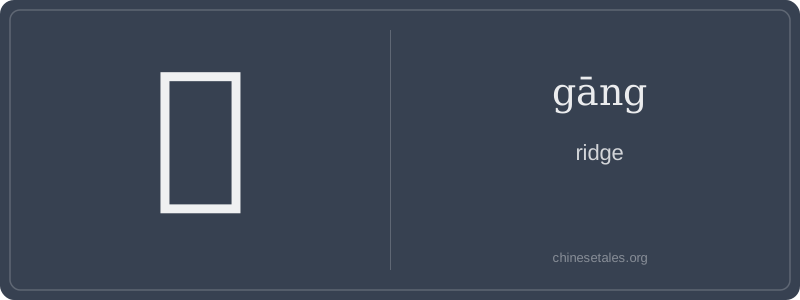
The earliest form of 冈 appears in oracle bone inscriptions as a simple, elegant pictograph: two parallel diagonal strokes rising upward from a horizontal base—resembling twin slopes meeting at a sharp crest. Over time, during the bronze script era, the base became more pronounced and enclosed, evolving into the radical 冂 (jiōng), meaning ‘enclosure’ or ‘arch’, while the two upper strokes hardened into the distinct angular lines we see today. By the seal script period, the shape had stabilized: the outer frame (冂) cradling two inward-leaning strokes (丷), visually echoing the way a ridge rises symmetrically from lower ground—its flanks converging toward a central line.
This visual logic endured: the 冂 radical suggests containment or boundary, and the inner strokes evoke ascending contours—literally ‘the enclosed rise’. In classical literature, 冈 appears frequently in poetry to convey solemn stillness and endurance—like in the Book of Songs (Shījīng): ‘陟彼高冈,我马玄黄’ (Climb that high ridge—my horse grows weary and dark), where 冈 anchors the scene’s vertical tension. Its minimal stroke count (just four) makes it one of the most efficient visual metaphors in Chinese writing: less is more, and every line serves geography.
At its heart, 冈 (gāng) is not just any hill—it’s the quiet, enduring spine of the land: a long, narrow ridge rising above the surrounding terrain. Unlike 山 (shān), which evokes a full mountain with peaks and slopes, 冈 feels leaner, more linear—like the backbone of the earth itself. This subtle distinction matters deeply in Chinese landscape perception: ridges shape watersheds, define boundaries, and offer strategic vantage points—so 冈 carries connotations of continuity, division, and quiet authority.
Grammatically, 冈 is almost always a noun and rarely stands alone in modern speech; it appears primarily in compound words (e.g., 山冈, 冈峦) or poetic/literary contexts. Learners sometimes mistakenly treat it like a common noun they can freely modify—'a big 冈'—but native speakers would say 高冈 (gāo gāng, 'tall ridge') or use it only in set phrases. It’s also never used as a verb or adjective, unlike characters such as 上 (shàng) or 高 (gāo). Its four-stroke simplicity belies its stylistic weight—it’s a character you’ll see in classical poetry, place names, and historical texts, but rarely in daily chat.
Culturally, 冈 subtly reinforces the Chinese worldview that landforms are relational—not isolated objects, but connectors and dividers. A ridge doesn’t exist for itself; it separates valleys, channels wind, shelters villages. That’s why it appears in ancient place names like 八百里秦川 (the vast plain bounded by ridges around Xi’an) and in idioms like ‘翻山越岭’ (fān shān yuè lǐng)—where 冈 often replaces 岭 to emphasize the arduous, unbroken line of ascent. Mistake it for 山, and you lose that precise topographic nuance—like calling a cliff face a ‘hill’ in English.