岝
Character Story & Explanation
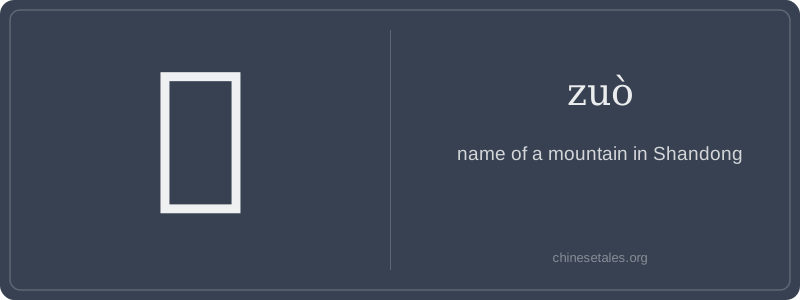
The character 岝 has no oracle bone or bronze script attestation — it’s a later creation, likely Han dynasty or after. Its form combines the mountain radical 山 (shān) on the left with 昜 (yáng, an archaic variant of 陽, meaning 'sunlit side') on the right. But here’s the twist: 昜 was borrowed purely for sound — zuò — not meaning. Visually, it’s a deliberate fusion: 山 anchors it geographically, while 昜 provides the pronunciation, making it a classic 'phono-semantic compound', though the semantic component is functionally redundant since the meaning is purely toponymic.
This character emerged because ancient cartographers needed a distinct, unambiguous way to label Zuòshān — avoiding confusion with other mountains named Yangshan or Yingshan. Unlike most characters, its meaning didn’t evolve; it was *born* frozen in place. No classical text uses it metaphorically or poetically — even in the Shanhai Jing, it appears only as a proper noun. Its visual weight (the bold 山 + complex 昜) mirrors its role: a sturdy, singular marker on the landscape — not a concept, but a coordinate.
Imagine you're hiking with a local guide near Qufu in Shandong, and he points to a mist-shrouded peak and says, 'That’s Zuòshān — not on any tourist map, but named in the Classic of Mountains and Seas over two millennia ago.' That’s 岝: a rare, geographically anchored character — not a generic word for 'mountain' like 山 (shān), but a proper noun *only* used in the name of one specific mountain. It carries zero abstract meaning; it exists solely as a phonetic-semantic fossil — a linguistic monument.
Grammatically, 岝 appears almost exclusively in the compound 岝山 (Zuòshān), functioning as an inseparable lexical unit. You’ll never see it alone, nor as part of verbs, adjectives, or modern compounds. Learners sometimes misread it as a variant of 座 (zuò, 'seat') or 作 (zuò, 'to do'), but those are unrelated homophones — using 岝 outside its fixed place name would be like writing 'Mount Eiffel' instead of 'Eiffel Tower'. It’s not used in speech or writing unless referring to that precise location.
Culturally, 岝 embodies China’s ancient tradition of naming sacred or notable terrain with unique characters — often invented just for that spot. It’s never taught in schools, rarely printed, and absent from digital fonts (causing rendering glitches). Mistake? Assuming it’s productive — it’s not. It’s a quiet, stubborn relic: pronounceable, unanalyzable, and utterly irreplaceable in its single context.