岜
Character Story & Explanation
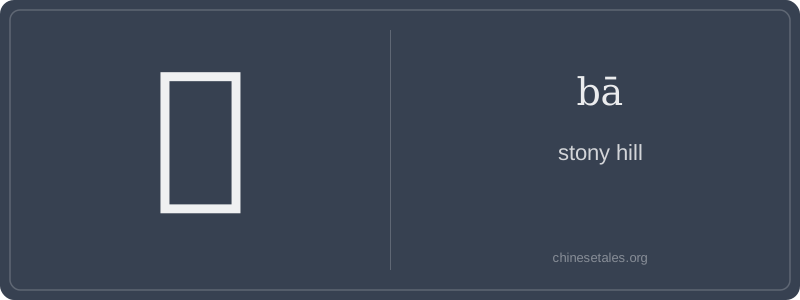
The earliest form of 岜 isn’t found in oracle bone inscriptions—it emerged much later, during the late Han to Tang periods, as a phonosemantic compound crafted for regional geography. Its left side, 山 (shān), is the unmistakable 'mountain' radical—three jagged peaks rendered with three short strokes. Its right side, 巴 (bā), was borrowed not for meaning but sound: it provided the pronunciation while subtly reinforcing the idea of something 'clinging' or 'adhering'—like rock strata clinging tightly to a slope. Visually, the modern 岜 (7 strokes) balances these two elements: 山 (3 strokes) on the left, 巴 (4 strokes) on the right—no extra flourishes, just functional clarity.
Over time, 岜 never entered classical poetry or philosophical texts; instead, it rooted itself in local gazetteers and land deeds of Guangxi and Yunnan. In Ming-dynasty records, 岜 appears in names like 岜赖 (Bā Lài) and 岜更 (Bā Gēng)—always paired with another syllable, always denoting a specific outcrop or limestone knoll. The character’s simplicity belies its precision: unlike broader terms, 岜 implies not just elevation but geology—exposed bedrock, sparse vegetation, and terrain resistant to farming or roads. Its visual compactness (just 7 strokes) mirrors the physical compactness of the hills it names: small, sharp, and self-contained.
Think of 岜 (bā) as China’s linguistic equivalent of a ‘butte’—those isolated, steep-sided hills rising abruptly from flat plains in the American Southwest. Unlike generic terms like 山 (shān, 'mountain') or 丘 (qiū, 'hill'), 岜 carries a distinct geological texture: it specifically evokes a small, rocky, often barren hill—rugged, unyielding, and deeply local. It’s not poetic or grand; it’s practical, earthy, and hyper-regional—used almost exclusively in southern Chinese toponyms, especially in Zhuang-influenced areas of Guangxi.
Grammatically, 岜 is nearly always a noun and almost never stands alone in speech—it’s a place-name fossil. You’ll see it only in compound proper nouns like 岜山 (Bā Shān) or 岜弄 (Bā Nòng), never in verbs, adjectives, or everyday phrases. Learners sometimes mistakenly try to use it like 山 ('mountain') in expressions such as 'climb a 岜'—but that’s unnatural; native speakers say 攀登岜山 (pāndēng Bā Shān), treating 岜 as inseparable from its full name. It doesn’t conjugate, pluralize, or take modifiers like common nouns do—it’s more like a proper noun suffix than a free-standing word.
Culturally, 岜 is a quiet testament to linguistic layering: its pronunciation and usage preserve Zhuang language influence—the syllable 'ba' mirrors Zhuang words for 'rocky hill' or 'cliff', and many 岜-names predate Han settlement. A common mistake is misreading it as 巴 (bā, 'to long for') due to identical pinyin and similar stroke count—but 巴 has no mountain radical and zero geographical meaning. This character doesn’t appear in literature or media; it lives in survey maps, village signs, and GPS coordinates—unseen by most Mandarin speakers, yet stubbornly present in the land itself.