岌
Character Story & Explanation
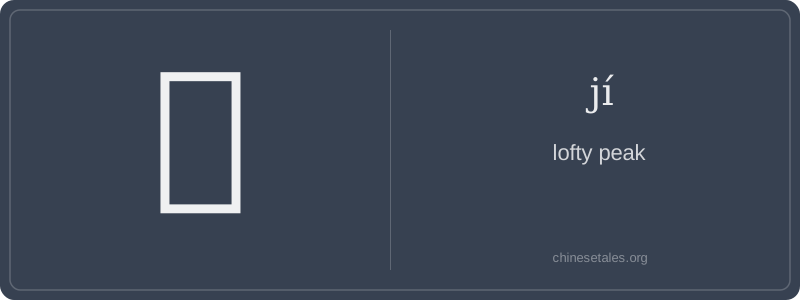
The earliest forms of 岌 appear in bronze inscriptions from the late Zhou dynasty — not as a standalone pictograph, but as part of compound glyphs representing high, jagged ridges. Its structure is elegant logic: the radical 山 (shān) forms the base — three peaks, unmistakably mountainous — while the top component, originally a stylized depiction of 'two stacked stones' or 'twin summits', evolved into the two dots (丶丶) we see today. Over centuries, the middle stroke simplified, the peaks sharpened, and the upper dots became standardized — preserving the idea of 'height multiplied, balance strained'.
By the Han dynasty, 岌 was already paired with itself (岌岌) in texts like the *Book of Rites* to describe ritual platforms so elevated they seemed to tremble — a metaphor later extended to moral authority, dynastic stability, and even personal reputation. The visual duality is key: the solid 山 grounds the character, while the floating dots above suggest aspiration straining against gravity — a perfect visual metaphor for 'lofty peak' that’s both majestic and unnervingly unstable.
Think of 岌 (jí) as the quiet, dramatic cousin of more common mountain characters like 山 (shān) or 峰 (fēng). It doesn’t just mean 'mountain' — it evokes a very specific, almost literary image: a steep, towering, precarious peak — one that seems to scrape the sky and dare gravity to pull it down. In classical Chinese, it’s rarely used alone; instead, it appears in poetic compounds like 岌岌 (jí jí), where reduplication intensifies the sense of looming height *and* instability — like a cliff edge trembling under its own grandeur.
Grammatically, 岌 is almost always bound — you’ll almost never see it solo in modern usage. It functions exclusively within fixed two-character adjectives (e.g., 岌岌可危 jí jí kě wēi — 'precariously close to collapse'), never as a noun or verb. Learners sometimes mistakenly try to use it like 山 ('mountain') — say, *'this mountain is 岌'* — but that’s ungrammatical and nonsensical. It’s not descriptive of terrain; it’s an atmospheric, evaluative modifier with built-in tension.
Culturally, 岌 carries the weight of classical elegance — it appears in Tang poetry and Song essays to evoke awe mixed with unease. Modern speakers use it almost exclusively in formal or rhetorical contexts: political speeches, editorial critiques, or literary descriptions. A common learner trap? Confusing its tone — it’s *jí* (second tone, rising), not *jī* (first tone) — and misreading its radical: yes, it’s 山, but those two dots on top aren’t decorative — they’re crucial visual cues for its 'lofty, teetering' feel.