岊
Character Story & Explanation
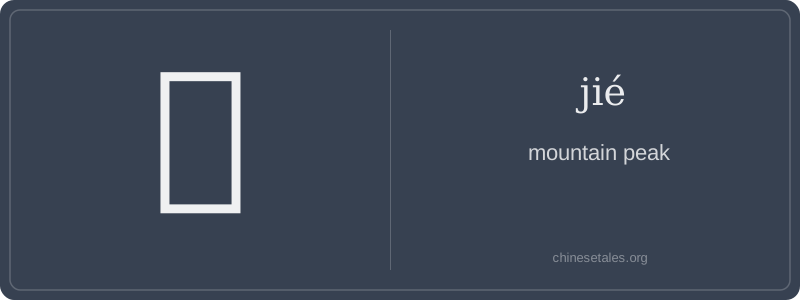
The earliest form of 岊 appears in bronze inscriptions as a stylized mountain (山) topped with a distinctive angular stroke — not a simple dot or line, but a jagged, upward-thrusting glyph resembling a fractured rock spire. Over centuries, the mountain radical (山) stabilized at the top, while the lower component evolved from a pictograph of a pointed crag into the modern ‘介’ (jiè) shape — though crucially, this ‘介’ is *not* the standalone character meaning ‘to introduce’; it’s a phonetic-semantic fusion, preserving both the sharp visual and the jié sound. The strokes coalesced into today’s elegant, asymmetrical structure: three horizontal lines (mountain peaks) crowned by a compact, angular ‘介’ anchoring the meaning in elevation and edge.
This visual logic held firm across dynasties. In the *Shuōwén Jiězì* (121 CE), Xu Shen defined 岊 as ‘the highest point of a mountain ridge’, citing its use in describing the ‘knife-edge ridges’ of southern Fujian’s granite ranges. Tang poets like Du Fu used it sparingly to evoke desolation and height — ‘云岊生寒’ (yún jié shēng hán, ‘cold rises from the cloud-tipped ridge’) — where the character’s shape mirrors the image: narrow, elevated, elemental. Its endurance lies in that perfect match between form and function: every stroke suggests ascent, exposure, and the meeting of earth and sky.
Imagine standing on a narrow, wind-scoured ridge in the Wuyi Mountains at dawn — not the broad summit of a famous peak like Huangshan’s Lotus Peak, but that razor-thin, almost precarious spine where sky and stone meet. That’s the *feel* of 岊 (jié): not just 'mountain peak' in the generic sense, but the sharp, exposed, often solitary crest — the very tip of a mountain’s crown, where the air thins and the view opens in all directions. It’s poetic, precise, and rarely used in casual speech; you’ll find it mostly in classical poetry, place names (like Yúnjié 山), or descriptive prose aiming for lyrical austerity.
Grammatically, 岊 is a noun that almost never stands alone. You won’t say *‘I climbed a jié’* — instead, it appears embedded: as part of a compound (e.g., 山岊) or modified by classifiers like ‘一座’ (yī zuò) or adjectives like ‘险峻的’ (xiǎnjùn de). It resists verbs like ‘有’ (yǒu) or ‘在’ (zài) without context — saying ‘山有岊’ sounds archaic or incomplete. Modern speakers prefer 峰 (fēng) or 顶 (dǐng); 岊 feels like choosing ‘summit’ over ‘top’ — same idea, but with literary weight and geographic specificity.
Culturally, 岊 carries the quiet authority of classical diction. Mistaking it for a common word leads to awkwardness — it’s not ‘peak’ as in ‘peak performance’ (that’s 高峰 gāofēng), nor does it mean ‘hill’ (丘 qiū) or ‘cliff’ (崖 yá). Learners often misread its tone (it’s jié, not jiē or jiě) or assume it’s interchangeable with 峰. But 岊 implies verticality, isolation, and visual sharpness — think silhouette against the sky, not rounded elevation.