屾
Character Story & Explanation
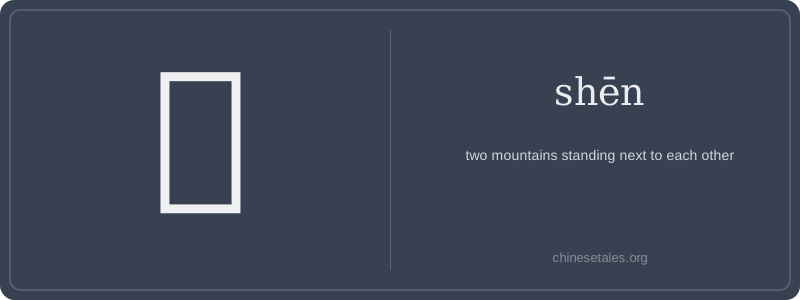
The earliest form of 屾 appears in Han dynasty seal script as two simplified, side-by-side 山 glyphs — each with three distinct peaks — stacked horizontally, not vertically. Unlike 山 (which evolved from a single jagged peak in oracle bone script), 屾 was *designed* as a duplication: two identical 山 radicals sharing one baseline, their central strokes subtly converging like mirrored slopes. Over time, the top peaks softened, the middle strokes merged slightly for calligraphic flow, and the final form stabilized at six strokes: two parallel vertical lines (the outer slopes), two short diagonal peaks above them, and two connecting horizontals below — a perfect bilateral symmetry.
This visual doubling wasn’t arbitrary: in Daoist and geomantic thought, paired mountains symbolized balance (yin-yang, earth-heaven resonance), and 屾 appears in texts like the *Shuǐ Jīng Zhù* (Commentary on the Water Classic) to describe sacred twin peaks guarding river valleys. Its meaning never broadened — unlike 山, which absorbed meanings like ‘hill’, ‘barrier’, or ‘abundance’ — 屾 remained stubbornly specific: only two mountains, adjacent, equal, silent. No metaphor, no extension — just pure, elegant duality.
Picture this: 屾 isn’t just ‘two mountains’ — it’s a quiet, symmetrical duet of peaks standing shoulder to shoulder, like twin sentinels on a misty horizon. Its core feeling is visual harmony and gentle repetition: not towering isolation (like 山 alone), but balanced, paired elevation. In classical Chinese, 屾 appears almost exclusively in literary or poetic contexts — never in daily speech or modern prose — and functions purely as a noun meaning ‘twin mountains’ or ‘adjacent peaks’. You’ll never see it in verbs, adjectives, or compounds like ‘mountain range’; it’s a fossilized pictorial noun, preserved like a brushstroke from Tang dynasty landscape poetry.
Grammatically, it behaves like a rare, standalone noun: it can be modified by numerals (e.g., 一屾) or descriptive phrases (e.g., 巍峨之屾), but it doesn’t combine freely — no 屾路, no 屾顶. Learners often mistakenly treat it like 山 and try to use it in compound words (‘shan + x’), or misread it as shān (the common mountain reading). But 屾 is *only* shēn — the ‘shēn’ sound echoes the idea of ‘deep resonance between two forms’, not ‘height’.
Culturally, 屾 is a whisper from China’s visual-literary tradition: it’s the kind of character you’d find carved into a scholar’s inkstone or tucked into a Song dynasty poem about stillness and duality. It’s so rare that even many native speakers have never seen it outside dictionaries — and if you use it conversationally, people will pause, squint, and ask, ‘Wait… is that *really* a word?’ That’s its charm: it’s not functional — it’s aesthetic archaeology on paper.