屼
Character Story & Explanation
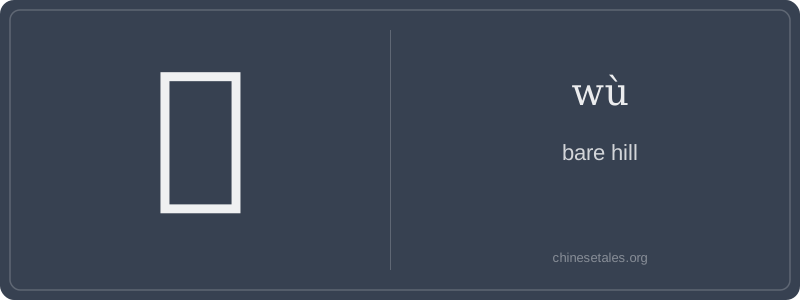
The earliest form of 屼 appears in seal script as a combination of 山 (mountain) on the left and 兀 (wù, meaning 'bare' or 'lofty and bald') on the right. 兀 itself originated from an oracle bone pictograph resembling a person standing on a raised platform with head conspicuously missing — a visual metaphor for 'topping out', 'stripped bare', or 'standing starkly exposed'. Over centuries, the left side standardized into the three-stroke 山 radical, while the right evolved from 兀’s simple dot-and-horizontal structure into its current form: a vertical stroke capped by a horizontal, then two downward strokes — like bare rock strata jutting upward.
This visual logic held firm through history: 屼 always meant a hill whose summit lacked vegetation — not because it was barren soil, but because wind, erosion, or geology had laid its bones bare. In the Shuō Wén Jiě Zì (121 CE), Xu Shen defined it as ‘a mountain without grass or trees’, citing its use in Han dynasty geographical records. Later, poets like Wang Wei used 屼 implicitly in phrases like ‘屼屼孤峰’ (a lone, bare peak) to evoke ascetic stillness — the character became less about topography and more about metaphysical emptiness made visible.
Imagine standing on a windswept ridge in northern China — no trees, no grass, just jagged limestone exposed to the sky. That’s the visceral feeling of 屼 (wù): not just any hill, but one stripped bare by time and weather. It’s a poetic, literary word — you won’t hear it in daily chat or HSK textbooks — but it appears in classical poetry, regional place names, and descriptive prose where precision matters: this isn’t a gentle slope; it’s a stark, skeletal elevation.
Grammatically, 屼 functions almost exclusively as a noun, often in compound nouns like 峨屼 or in fixed geographical terms (e.g., 龙屼山). It rarely stands alone in modern usage — you’d say ‘屼山’ not just ‘屼’. Learners sometimes mistakenly treat it as an adjective (‘bald hill’) and try to modify nouns directly (e.g., *屼的山), but that’s ungrammatical; it’s inherently part of a compound or proper name. Think of it like ‘tor’ in English — evocative, specific, and bound to landscape vocabulary.
Culturally, 屼 carries quiet austerity — it’s associated with Daoist reclusion and Tang dynasty frontier poetry, where barren hills symbolize both isolation and clarity. A common mistake is misreading it as wū (like 屋) due to the ‘兀’ component, but the radical ‘山’ anchors its meaning firmly in terrain. Also, don’t confuse it with similar-looking characters like 岌 or 峭 — those imply danger or steepness, while 屼 emphasizes *exposure*, not angle.