屺
Character Story & Explanation
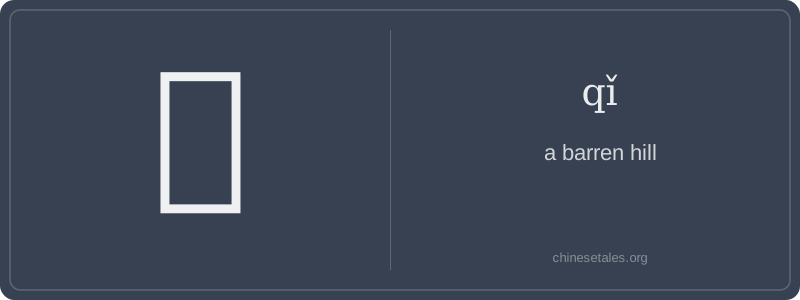
The earliest form of 屺 appears in bronze inscriptions as a stylized hill with two stark, angular peaks rising sharply—no trees, no curves, just sharp, upright strokes suggesting exposed bedrock. Over centuries, the top simplified into two horizontal lines (一 一), representing the bare crest, while the lower part evolved into the standard 山 radical—retaining the essence of elevation but shedding pictorial detail. The six-stroke modern form preserves this duality: the two short horizontals above the 山 radical visually echo a cracked, wind-scoured summit—no frills, no foliage, just raw geology.
This visual austerity directly shaped its meaning: in the Classic of Poetry (Shījīng), 屺 appears in verses mourning exile—‘陟彼屺兮,瞻望母兮’ (‘I climb that barren hill, gazing toward my mother’)—where the emptiness of the hill mirrors emotional desolation. Later, in Li Bai’s poems, 屺 evokes solitude and transcendence, not hardship. Its form never softened; even in clerical script, the two upper strokes remained stubbornly flat and unadorned—refusing to become lush or fertile, just as the word refuses to mean anything but bare, silent height.
Imagine standing on a windswept, treeless hill—no soil to hold roots, no birdsong, just rock and silence. That’s the visceral feel of 屺 (qǐ): not just any hill, but one stripped bare by time or weather. Its core meaning is deeply poetic: a barren, unadorned, almost austere elevation—think lunar landscape, not pastoral slope. In classical Chinese, it appears almost exclusively in literary or poetic contexts, never in everyday speech or modern administrative language. You won’t hear it in subway announcements or weather reports; you’ll find it in Tang dynasty poetry or Song-era travel essays describing remote, spiritually resonant terrain.
Grammatically, 屺 functions as a noun and almost always appears in compound terms (like 峭屺 or 峤屺) or paired with other mountain-related characters (e.g., 岨屺). It rarely stands alone—and when it does, it’s usually in parallel structure for rhythmic effect: ‘山高而屺,水深而渊’ (‘Mountains rise high and barren; waters run deep and profound’). Learners sometimes mistakenly treat it like a generic synonym for 山 (shān, ‘mountain’) or 岭 (lǐng, ‘ridge’), but doing so strips away its essential connotation of desolation and quiet majesty.
Culturally, 屺 carries a Daoist-tinged reverence for austerity—it evokes wu wei (effortless action) through absence, not presence. A common mistake is misreading it as qī (like 七) due to tone similarity, or confusing its radical (山) with the character 丘 (qiū, ‘mound’) which looks deceptively similar but implies gentle, rounded earth—not rocky barrenness. Also, while it shares the ‘mountain’ radical, it’s never used in place names today (unlike 峰 or 岭), making it a true relic of literary diction.