屹
Character Story & Explanation
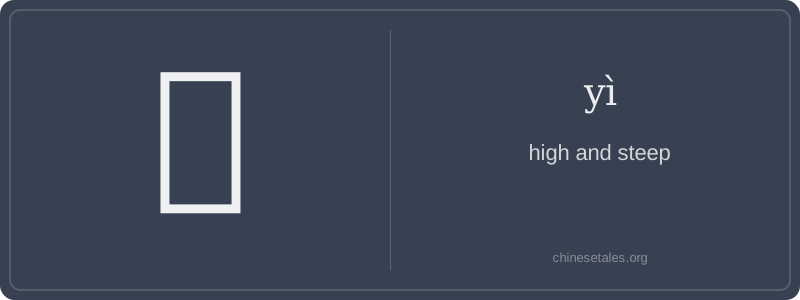
The earliest form of 屹 appears in seal script (c. 3rd century BCE), where it clearly combines 山 (mountain) on the left with 乞 (qǐ, originally a pictograph of a bent person begging — but here repurposed phonetically) on the right. Though 乞 looks like 'beg', its role here is purely sound-based: in Old Chinese, 乞 was pronounced *ŋ̊ʰrɯɡʔ*, close enough to *ŋrɯɡ* — the ancestor of modern yì. The mountain radical wasn’t decorative; it anchored the meaning in terrain — specifically, the sheer, vertical face of a peak, not its height alone. Over centuries, the right-hand component simplified from 乞’s curved, kneeling shape into today’s clean, angular 乞-like form — four strokes that now look deceptively like 'seven' (七), but aren’t.
This character first appeared in classical texts like the Wen Xuan (6th c. CE anthology), describing cliffs 'rising like teeth' (崢嶸屹屼). By the Tang dynasty, poets like Du Fu used 屹 to evoke moral fortitude: a sage ‘standing firm like a mountain’ — shifting from literal topography to ethical immovability. Its visual structure reinforces this: the mountain radical grounds it, while the upright, narrow right side mirrors the steepness it names — no curves, no compromise. Even today, calligraphers emphasize the vertical stroke in 乞 to echo a cliff’s drop.
Think of 屹 (yì) as the visual whisper of a mountain’s unshakable spine — not just 'tall', but impressively steep and immovable. It carries gravity, dignity, and quiet authority. You won’t find it in daily chit-chat or HSK lists because it’s literary, poetic, and almost ceremonial: it appears in formal writing, classical allusions, and fixed expressions — never alone as a verb or adjective in casual speech. It’s always paired, like a dignitary who only appears with titles.
Grammatically, 屹 is nearly always found in reduplicated form yìyì (屹屹), or more commonly in the compound yìlì (屹立), meaning 'to stand tall and firm' — often metaphorically (a nation, principle, or person standing resolute). It’s never used predicatively (*‘This mountain is 屹’* is ungrammatical); instead, it functions adverbially or within verbs: yìlì bùdòng (屹立不动, 'stands unmoving'), yìrán (毅然, 'resolutely' — note: this one’s a homophone with different character 毅, but learners often misread it as 屹!).
Culturally, 屹 evokes Confucian steadfastness and Daoist mountain-as-wisdom imagery — think of Laozi’s 'the highest virtue is like a mountain'. Learners often mispronounce it as 'yī' (first tone) or confuse it with 易 (yì, 'easy') or 义 (yì, 'righteousness'). Its rarity makes it a 'hidden gem' — spotting it in a newspaper headline or poem signals deliberate gravitas. And yes, you’ll see it on stone inscriptions at temple gates — literally carved into rock to match its meaning.