屴
Character Story & Explanation
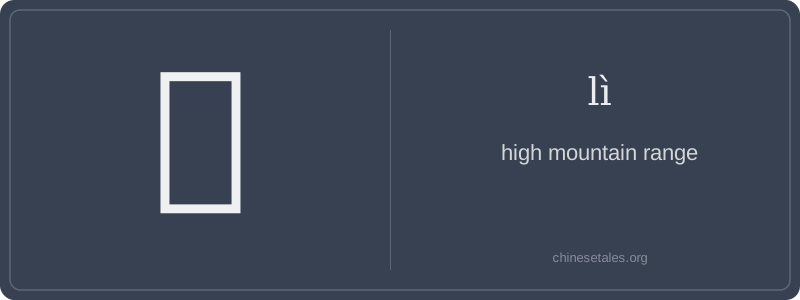
The earliest trace of 屴 appears not in oracle bone script, but in late Warring States bronze inscriptions and early clerical script, where it emerged as a deliberate doubling of 山 (shān, ‘mountain’) — not literally two mountains, but one mountain rendered with exaggerated, jagged peaks rising in layered, rhythmic succession. Visually, the left side is the standard 山 radical (three peaks), while the right side evolved from a simplified, upward-thrusting variant of 山 — almost like a mirrored echo, suggesting repetition, intensity, and unbroken height. Over centuries, strokes streamlined, but the dual-mountain motif remained central.
This doubling wasn’t arbitrary: in classical Chinese aesthetics, repetition signified abundance, endurance, and transcendence — so 屴 didn’t just mean ‘tall mountain,’ but ‘mountain whose height defies measure.’ It appears in Du Fu’s poetry (e.g., ‘屼屼见孤峰’) and the 12th-century geographical treatise Yù Hǎi, always paired with 岍 or 岌 to evoke vertical sublimity. Its form — two mountains stacked in tension — mirrors its meaning: nature’s silent, overwhelming verticality made visible.
Let’s be honest: 屴 (lì) is a rare, poetic ghost of classical Chinese — not something you’ll see on subway signs or WeChat chats. Its core meaning evokes the awe-inspiring, almost mythic presence of towering mountain ranges — not just ‘high mountains,’ but the kind that seem to pierce the heavens and command silence from mortals below. Think less ‘hiking trail’ and more ‘the spine of the earth rising in solemn grandeur.’ It carries weight, majesty, and a quiet, ancient dignity.
Grammatically, 屴 never stands alone in modern usage — it only appears fused with its twin in the compound 屴屼 (lì wù), an elegant, literary binome meaning ‘lofty and precipitous’ (often describing cliffs, ridges, or even metaphorical obstacles). You won’t conjugate it, pluralize it, or use it as a verb — it’s purely descriptive, adjectival, and deeply formal. Learners sometimes misread it as lì (like 立) and assume it means ‘to stand,’ but that’s a dangerous mix-up: 屴 isn’t about posture — it’s about vertical immensity.
Culturally, 屴 belongs to the lexicon of Tang poetry and Song landscape painting — where mountains weren’t scenery but cosmic forces. Modern writers might deploy 屴屼 for rhetorical gravitas in essays or historical novels, but never in casual speech. A common mistake? Trying to parse it as two separate radicals; in reality, it’s a single semantic unit built from 山 (mountain) plus a stylized ‘upward surge’ — a visual shout of elevation.