屯
Character Story & Explanation
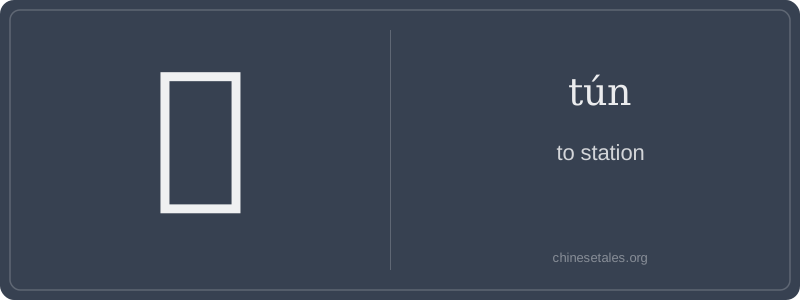
The earliest form of 屯 appears in oracle bone inscriptions as a pictograph resembling a sprout pushing stubbornly upward through cracked earth — a single curved line (like a seedling’s coiled shoot) beneath a horizontal stroke representing soil. Over time, the sprout evolved into the left-side component (), while the soil hardened into the top horizontal and the two short strokes beneath became the modern 屮 radical — originally meaning 'sprouting plant'. The right side solidified into the vertical stroke with a hook, anchoring the whole image: life emerging *and holding its ground*. By the seal script era, it looked nearly like today’s 屯 — compact, rooted, resilient.
This botanical origin is key: 屯 didn’t start as 'military stationing' — it began as 'to sprout, to germinate, to take root'. In the *Yijing* (I Ching), the first hexagram is named 屯 (zhūn), symbolizing primal difficulty at the dawn of creation — like a seed struggling to break through soil. Only later did the meaning extend metaphorically to 'establishing presence', then concretely to 'stationing troops' (e.g., in Han dynasty military records). The visual logic holds: just as a seed must anchor itself before growing, troops must 'take root' in a location to hold it.
At first glance, 屯 (tún) feels like a quiet, sturdy little character — just four strokes, yet it carries the weight of military discipline and strategic patience. Its core meaning is 'to station' or 'to garrison': think troops settling into position, supplies stockpiled at a forward base, or even data cached in memory (yes — tech uses it too!). Unlike action verbs like 放 (fàng, 'to put') or 安排 (ānpái, 'to arrange'), 屯 implies deliberate, sustained presence — not a quick placement, but an occupation with purpose and endurance.
Grammatically, 屯 is almost always a verb, and it’s transitive: you 屯 something *somewhere*. You’ll see it in formal or technical contexts — rarely in casual chat. For example: 我们在边境屯兵 (wǒmen zài biānjìng tún bīng) — 'We station troops along the border.' Notice it doesn’t take aspect particles like 了 or 过 easily; it’s more about state than event. Learners often mistakenly use it like 存 (cún, 'to save/store') — but while you can 屯粮 (tún liáng, 'stockpile grain'), you wouldn’t 屯钱 (tún qián); for money, you’d say 存钱. That subtle boundary matters!
Culturally, 屯 evokes ancient frontier logistics — the Great Wall wasn’t just built; it was *staffed*, *supplied*, and *sustained* — all verbs wrapped in this tiny glyph. Modern slang has playfully extended it to digital life: 屯电子书 (tún diànzǐ shū, 'hoard e-books') — jokingly implying you’ve amassed them but haven’t read them yet. It’s a gentle tease, rooted in the character’s enduring sense of 'accumulation with intent.'