屮
Character Story & Explanation
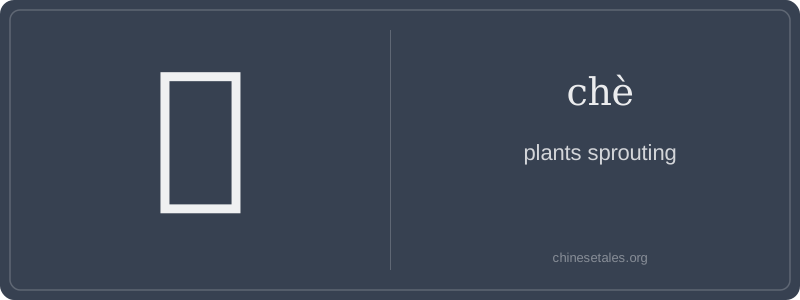
The earliest form of 屮 appears in oracle bone inscriptions as two delicate, diverging strokes rising from a shared base — like twin tender shoots unfurling from a single seed node. No roots, no leaves, just pure upward motion: two lines bending slightly outward, mimicking the way cotyledons part as they pierce the soil. Over centuries, the shape simplified: the base became a short horizontal stroke, the two arms shortened and straightened into clean, angled diagonals — evolving into today’s three-stroke form: 一 (horizontal base) + 丿 (left-slanting sprout) + 乀 (right-slanting sprout). Every stroke is intentional — no flourish, no extra dot. It’s botanical minimalism.
This character appears in the Shuōwén Jiězì (121 CE), China’s first dictionary, where Xu Shen defines it as 'the appearance of sprouting plants' — not 'plant', not 'leaf', but the *act* of emerging. In classical poetry, it rarely surfaces alone, but its spirit pulses in phrases like '屮木' (cǎo mù, 'grasses and trees'), where 屮 subtly reinforces the idea of spontaneous, unbidden life. Its visual form — two strokes reaching skyward — became a template for vitality itself, later embedded in radicals like 艹 (cǎo zì tóu, 'grass radical'), which is literally a doubled, stylized 屮.
Imagine a tiny green shoot pushing through dark soil — that’s 屮 (chè) in essence: not a full plant, not a leaf or stem, but the very first moment of emergence. It’s one of Chinese’s oldest pictographs, capturing life’s fragile, upward thrust before language had grammar or abstraction. In classical texts, it rarely stands alone as a word; instead, it functions almost like a visual root — a semantic seed embedded in characters for plants, growth, and vitality (like 草 cǎo 'grass' or 芸 yún 'to cultivate'). You’ll never see it on a menu or hear it in daily speech — it’s a fossilized building block, not a living vocabulary item.
Grammatically, 屮 has zero modern standalone usage. Learners won’t conjugate it, pluralize it, or use it in sentences — because it doesn’t work that way. It’s not a noun you can count ('three 屮') or a verb you can tense ('I 屮-ed yesterday'). Its 'grammar' is etymological: it appears only inside other characters, quietly lending its 'sprouting' energy. Mistaking it for a usable word (e.g., trying to say 'chè' instead of 'cǎo' for 'grass') is like pronouncing the letter 'g' instead of saying 'green' — it’s the raw material, not the message.
Culturally, 屮 embodies the Daoist and agricultural reverence for beginnings: the quiet, unstoppable force of life breaking surface. It’s why so many plant-related characters contain it — not as decoration, but as philosophical DNA. A common learner trap? Confusing it with 已 (yǐ, 'already') or 丕 (pī, 'great') due to similar stroke flow. But 屮 isn’t about time or scale — it’s about verticality, vulnerability, and the first breath of green.