屪
Character Story & Explanation
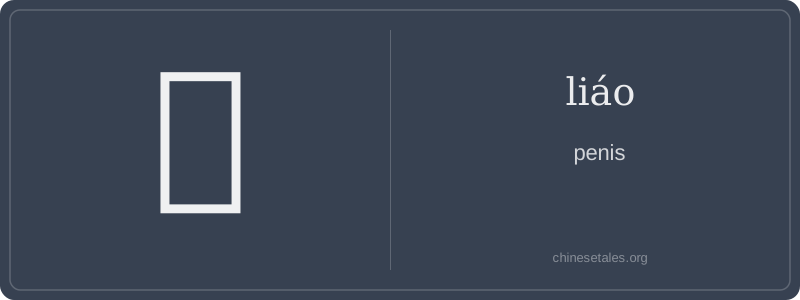
The character 屪 does not appear in oracle bone or bronze inscriptions — it’s a late, vernacular creation. Its earliest attested form appears in Ming dynasty vernacular novels and Qing dynasty folk texts as a phonetic-semantic compound: the left radical 尸 (shī, 'corpse' or 'body part') signals the bodily domain, while the right component 辽 (liáo, 'distant') was borrowed purely for sound — no semantic link to geography. Visually, it’s minimalist: just 尸 + 辽, with no extra strokes added over time. There’s no pictographic origin; it was invented as a 'sound-alike' taboo avoidance character — a way to write the vulgar spoken word without spelling it directly.
This clever workaround let writers hint at the taboo term while staying plausibly deniable — much like English writers once used 'g--d' or 'd--n'. By the late Qing, 屪 had crystallized into a lexicalized intensifier, shedding its literal meaning almost entirely. Classical texts never use it; you won’t find it in the Shuōwén Jiězì. Instead, it thrives in dialogue-heavy works like The Scholars (Rúlín Wàishǐ) — not as anatomy, but as rhetorical heat. Its visual simplicity (just 8 strokes, not 0 — a common myth!) mirrors its function: lean, blunt, and impossible to ignore once seen.
Imagine walking into a Beijing hutong and overhearing two uncles arguing loudly over mahjong — one shouts, 'Nǐ zhè gè liáo rén!' (You shameless fellow!), not referring to anatomy at all, but using 屪 as a fiery, vulgar intensifier like 'damn' or 'freaking' in English. That’s the real-life heartbeat of this character: it’s almost never used literally for 'penis' in modern speech — that sense is archaic, clinical, or shockingly crude. Instead, it lives on in explosive slang compounds like liáo cǎo (lit. 'penis grass') meaning 'bullshit', or as a standalone curse in regional dialects (especially Shandong and Northeastern Mandarin), where it punches up anger, mockery, or disbelief.
Grammatically, 屪 behaves like a noun but functions more like an interjection or emphatic prefix. You won’t say 'wǒ yǒu yī gè liáo' — that’s textbook-incorrect and socially nuclear. Rather, you’ll hear 'liáo de!' (Damn it!) or 'liáo dàn!' (literally 'penis egg' = 'nonsense!'), always in fixed, colloquial phrases. Learners who try to use it as a neutral anatomical term risk sounding either like a 19th-century medical text or a very angry teenager — neither appropriate for polite conversation or HSK exams.
Culturally, 屪 is a linguistic fossil: its rawness reflects pre-modern Chinese taboos around bodily terms, where euphemisms (like jī ba, yīn jīng) replaced direct usage centuries ago. Today, it survives only in oral, informal, often humorous or confrontational contexts — never in writing outside internet memes, satirical fiction, or linguistic studies. Mistake it for a 'safe' synonym of jī ba? You’ll instantly mark yourself as a textbook-only learner with zero street-level intuition.