屣
Character Story & Explanation
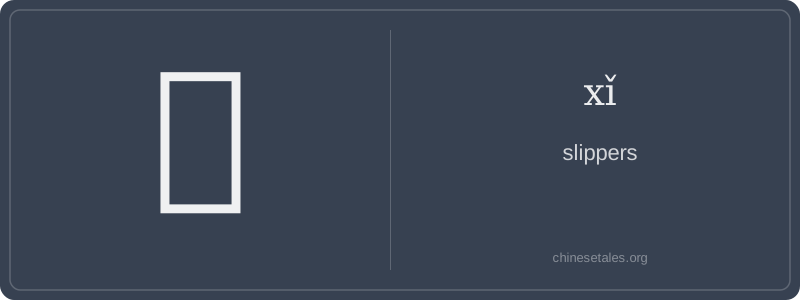
The earliest form of 屣 appears in bronze inscriptions of the Warring States period (475–221 BCE), where it was written with 尸 (a stylized depiction of a person crouching or reclining) on top and 徒 (tú, 'on foot' or 'barefoot') below — not the modern 舌. Over centuries, the lower component simplified and rotated, eventually resembling 舌 (tongue), though unrelated in meaning. The 尸 radical anchors it firmly in the domain of the human body and domestic space — not as a corpse (its literal meaning), but as the 'person at rest', seated or preparing to enter a clean, sacred, or intimate area. This visual logic persists: slippers are what you wear when your body is transitioning — from outside to inside, public to private, active to still.
By the Han dynasty, 屣 had solidified as a literary term for soft, indoor footwear, often contrasted with sturdy outdoor shoes. The famous Eastern Jin poet Tao Yuanming wrote of '脱屣如脱尘' ('shedding slippers like shedding dust'), using 屣 as a metaphor for effortless renunciation of worldly attachments. Its shape — 尸 over 舌 — became a mnemonic for 'the body (尸) puts its tongue (舌) down to rest' — i.e., pauses speech and movement upon entering a refined space. Even today, traditional tea ceremonies or calligraphy studios may reference 屣 to evoke this hushed, grounded reverence.
At first glance, 屣 (xǐ) feels like a quiet, almost dusty word — it means 'slippers', yes, but not the fluffy, modern kind you’d wear with pajamas. In Chinese, it carries an air of antiquity and modesty: think worn leather or woven hemp slippers slipped off at the threshold before entering a home or temple. It’s not casual footwear; it’s ritual footwear — a small act of humility and respect baked into daily life. You’ll rarely hear it in spoken Mandarin today (most people say 拖鞋 tuōxié), but it lives on in classical poetry, idioms, and formal writing, where it evokes quiet dignity, transience, or even disposability ('as disposable as old slippers').
Grammatically, 屣 is a noun that almost never stands alone. It appears in fixed compounds (like 屐屨 jīlǚ — sandals and slippers) or poetic parallelisms. You won’t say *'I bought a 屣' — instead, it’s always paired: 木屐屨 (wooden clogs and slippers), or used metaphorically: '视若敝屣' (to regard something as worthless as a broken slipper). Its tone (xǐ, third tone) rhymes with 喜 (joy), but ironically, it often signals neglect or discard — a subtle linguistic wink.
Learners often misread 屣 as a generic 'shoe' character — but it’s far more specific and culturally loaded. Confusing it with 鞋 (xié, 'shoe') is common, yet disastrous: 鞋 covers everything from sneakers to boots; 屣 is only the humblest, most temporary foot-covering — the kind you kick off without thinking. Also, because it’s absent from HSK and rarely used conversationally, learners who encounter it in Tang poetry or calligraphy may assume it’s obsolete — but its endurance reveals how deeply Chinese culture embeds meaning in small, domestic gestures.