屠
Character Story & Explanation
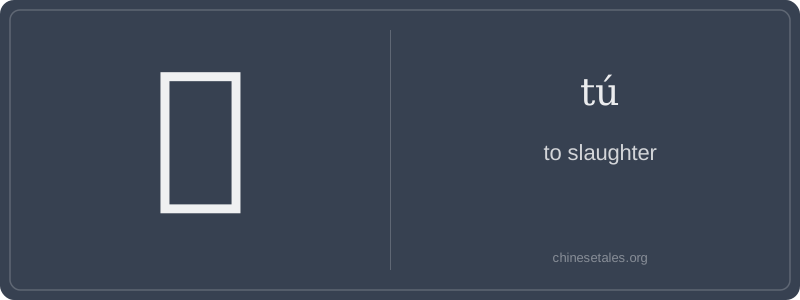
The earliest form of 屠 appears in bronze inscriptions (c. 1000 BCE) as a compound pictograph: the top half resembled a hand holding a sharp tool (like a cleaver or axe), and the bottom was 尸 (shī), meaning 'corpse' or 'body laid out'—not the modern 'corpse' connotation, but a ritual posture of submission or stillness. Over centuries, the tool morphed into the left-hand component 丿一 (a stylized blade), while 尸 solidified as the radical at the bottom. By the Small Seal Script (Qin dynasty), the structure locked in: a blade descending onto a prone figure—visually, an act of cutting into still flesh.
This visual logic shaped its semantic evolution. In the Shuōwén Jiězì (121 CE), Xu Shen defined 屠 as 'cutting up meat after slaughter', emphasizing post-mortem butchery—not killing itself. That nuance persisted: Confucian texts distinguish 屠 (ritual dismemberment of sacrificial animals) from 杀 (killing). The famous butcher Ding in the Zhuangzi doesn’t just kill cattle—he 屠 them with meditative precision, turning butchery into art. So the character isn’t about death alone; it’s about the disciplined, skilled transformation of life into sustenance—and by extension, of chaos into order.
Imagine a bustling ancient market in Chang’an—smoke curls from iron cauldrons, and a butcher in coarse hemp robes stands before a freshly slaughtered ox. His cleaver rests on the chopping block beside the character 屠 carved into the wood: not a label, but a declaration of craft and consequence. That’s tú: not just ‘to slaughter’, but to perform a decisive, ritualized act of ending life for sustenance or sacrifice. It carries weight—gravity, finality, even solemnity—not casual violence. You’ll rarely hear it in everyday speech (‘kill’ is usually 杀 shā), but you’ll see it in formal, literary, or historical contexts: 屠城 (tú chéng, 'to sack a city'), 屠龙 (tú lóng, 'to slay a dragon' — metaphorically, an impossible feat).
Grammatically, 屠 is almost always a transitive verb requiring a direct object—no passive voice or abstract usage without an explicit target ('He slaughtered *the pig*', never 'He slaughtered *well*'). Learners sometimes wrongly substitute it for 杀 in colloquial sentences like 'I killed the mosquito' (that’s 杀 sī, not 屠). Also, note its tone: second tone (tú), not fourth (tù)—mispronouncing it as tù risks sounding like 'vomit' (吐), which is… awkwardly memorable.
Culturally, 屠 appears in classical texts with moral gravity: Mencius condemns rulers who 'slaughter the people' (屠民) as tyrants, while Zhuangzi uses 屠者 ('butcher') to symbolize effortless mastery (think of the legendary butcher Ding in the Zhuangzi, whose knife never dulls after decades—not because he’s violent, but because he moves with Daoist precision). So while modern usage leans grim, its roots are in skill, duty, and cosmic order—not mere brutality.