屝
Character Story & Explanation
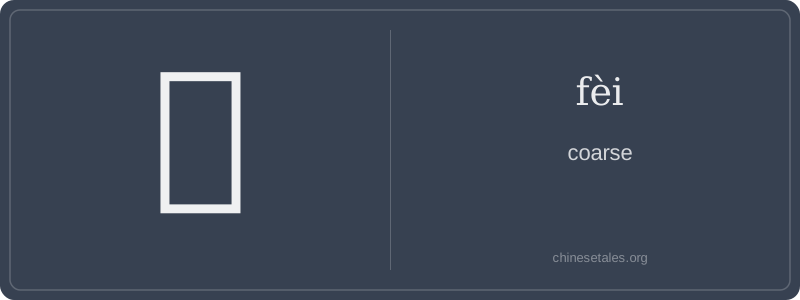
The earliest form of 屝 appears in bronze inscriptions as a composite glyph: the left side was a variant of 尸 (shī), depicting a person crouching or reclining — not a corpse, but a seated figure — and the right side was 帚 (zhǒu), a broom. Together, they painted a vivid scene: a person sweeping or tending to rough, bundled straw — the very material used to weave simple sandals. Over centuries, 尸 simplified into the modern 尸 radical (top-left), while 帚 eroded into the bottom-right component resembling 弊, losing its broom bristles but keeping the sense of ‘handled, processed raw material’.
This origin explains everything: 展 (to spread), 帚 (broom), and 屝 all share the idea of *manual processing of natural fibers*. In the Zuo Zhuan, 屝 appears in descriptions of frontier envoys wearing ‘屝履’ — sandals made from wild grasses, signaling humility and resilience. By the Tang dynasty, poets like Du Fu used 屝 metaphorically: ‘屝衣’ (fèi yī) meant garments of coarse hemp, symbolizing moral integrity untouched by luxury. The character never shed its tactile, artisanal weight — it’s not about grit, but about grain, texture, and intention.
Let’s be honest: 屝 (fèi) is a linguistic ghost — rare, elegant, and almost extinct in modern speech. Its core meaning isn’t just ‘coarse’ in the textural sense; it evokes *rough-hewn simplicity*: think straw sandals worn by ancient scholars trekking mountain paths, or coarse hemp cloth that breathes but scratches. It carries an aesthetic of humble authenticity — not poverty, but intentional austerity. You won’t hear it in daily chats; it lives in classical allusions, poetic descriptions, and literary criticism.
Grammatically, 屝 functions almost exclusively as an adjective before nouns (e.g., 屝履 — coarse sandals), never predicatively (*‘This cloth is 屝’* sounds deeply unnatural). Learners sometimes try to use it like 粗 (cū) — but 屝 is far more literary and narrower: it implies *handmade roughness with cultural resonance*, not general coarseness (like coarse salt or coarse behavior). It never modifies abstract concepts alone — you wouldn’t say 屝思想 (‘coarse thought’); that’s ungrammatical and semantically jarring.
Culturally, 屝 whispers of Daoist and early Confucian ideals — valuing unadorned function over ornament. Mistake it for 粗 or 糙, and you’ll sound either archaic or unintentionally comical. Also: it’s *not* used in compound verbs or as a verb — zero verbal usage in any period. Its rarity means even native speakers pause when encountering it — often checking dictionaries. That’s your cue: treat it like a silk scroll — admire its craftsmanship, don’t try to wear it every day.