屘
Character Story & Explanation
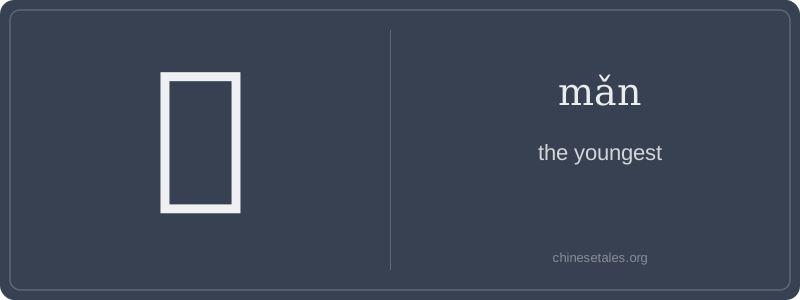
The character 屘 doesn’t appear in oracle bone or bronze inscriptions — it’s a later, regional creation. Its earliest attested form emerges in Ming-Qing vernacular manuscripts and local gazetteers, where it’s written with the radical ⺅ (jiǎo zì páng, 'walk' radical) on the left — suggesting movement or position — and 又 (yòu, 'again') on the right, possibly hinting at repetition, continuation, or 'the one who comes last'. Over time, 又 simplified into the modern 又-like shape, while the left side stabilized as ⺅ — not the more common 走 (zǒu) but its variant form emphasizing placement in sequence.
Its meaning crystallized in southern Chinese dialect literature: 屘 didn’t just mean 'youngest'; it carried connotations of being 'the final arrival' — the child who completes the lineage, the one who stays closest to aging parents. In Qing dynasty novels like Strange Tales from a Chinese Studio, characters refer to ‘阿屘’ affectionately when speaking of the baby brother. The visual logic is subtle but elegant: ⺅ grounds the person in familial space; 又 signals the ‘last occurrence’ — together, they say: ‘the one who walks in last in the family line.’
Let’s be honest: 屘 (mǎn) is a linguistic ghost — it’s real, it’s in dictionaries, and native speakers *recognize* it, but you’ll almost never hear it spoken in daily life. It means 'the youngest' — specifically the youngest child in a sibling group — and carries a gentle, almost poetic weight, like a quiet footnote in a family story. Unlike common words like 最小的 (zuì xiǎo de), which just means 'smallest', 屘 implies birth order *within a traditional kinship framework*, often evoking ancestral registers or literary nostalgia.
Grammatically, 屘 is a noun or nominal adjective — it rarely stands alone. You’ll see it in compounds (like 老屘) or after possessives: 他是家里的屘 (tā shì jiā lǐ de mǎn) — 'He is the youngest in the family.' Note: it’s *not* used predicatively like 是屘 — that sounds archaic or dialectal. Learners sometimes overextend it (e.g., ‘the youngest student’ → *屘学生), but no — use 最小的学生 instead. 屘 belongs to the family, not to categories like age groups or classes.
Culturally, 屘 reflects how deeply Chinese kinship terms encode hierarchy and position — even ‘youngest’ isn’t neutral; it subtly signals vulnerability, protection, and sometimes indulgence (think of the pampered 小儿子 or 小女儿). You’ll find it in regional speech (e.g., Fujianese or Hakka-influenced Mandarin), classical poetry allusions, and genealogical texts — but almost never in textbooks or apps. That’s why it’s not in HSK: it’s less a tool for communication than a whisper from China’s lexical attic.