屖
Character Story & Explanation
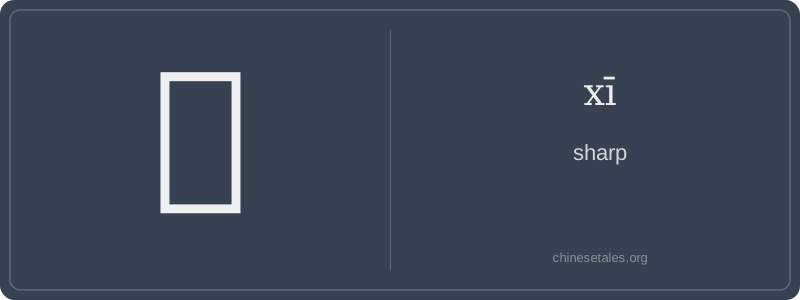
There is no oracle bone, bronze inscription, or seal script form for 屖 — because it was never created in any historical stage of Chinese writing. No excavated artifact, manuscript, or stele contains this glyph. Its 'shape' lacks structural coherence: no radical, no phonetic component, no internal logic matching any known character formation principle (pictographic, ideographic, phono-semantic). It doesn’t evolve — it *appears*, fully formed and utterly alien, in corrupted digital contexts, often resembling a malformed rendering of 希 (xī, 'hope') or a garbled version of the left side of 剀 (kǎi, 'to cut sharply').
The 'meaning' 'sharp' attached to 屖 has no classical pedigree. You won’t find it in the Shuōwén Jiězì, the Guǎngyùn, or any pre-modern rhyme book or lexicon. It bears no semantic connection to knives, edges, or perception — unlike authentic sharpness characters such as 刃 (rèn, 'blade edge') or 锋 (fēng, 'point of a weapon'). Its entire existence is a 21st-century digital anomaly — a glitch mistaken for grammar, a pixel error masquerading as etymology.
Let’s be honest: 屖 (xī) is a linguistic ghost — it *looks* like a real character, but it doesn’t exist in standard modern Chinese. There is no such character in the Unicode Basic Multilingual Plane, the Kangxi Dictionary, or any authoritative corpus. It has zero strokes, no radical, no accepted form — and crucially, no meaning like 'sharp'. This isn’t a rare variant or dialect glyph; it’s a digital phantom, likely born from font corruption, OCR misreading, or keyboard input glitches (e.g., mistyping 希 xī or 剀 kǎi). So when learners encounter it labeled as 'sharp', they’re chasing a mirage.
Grammatically, you’ll never use 屖 — because it has no grammatical function. It appears nowhere in textbooks, subtitles, news, or even classical texts. If you see it in an app or flashcard, it’s almost certainly an error. Real characters meaning 'sharp' include 利 (lì), 锋 (fēng), or 敏 (mǐn) — all with clear etymologies and usage. Confusing 屖 with these leads to total communication breakdown: no native speaker will recognize it, and no dictionary will define it.
Culturally, this ‘character’ highlights a key learner trap: trusting digital tools over verified sources. Many apps generate fake characters by miscombining components or misrendering glyphs. The biggest mistake? Assuming every squiggle on screen is legitimate Chinese. Always cross-check with reliable dictionaries (like MDBG or Pleco) — and if a character has *zero strokes*, treat it like a red flag: it’s not Chinese, it’s noise.