尹
Character Story & Explanation
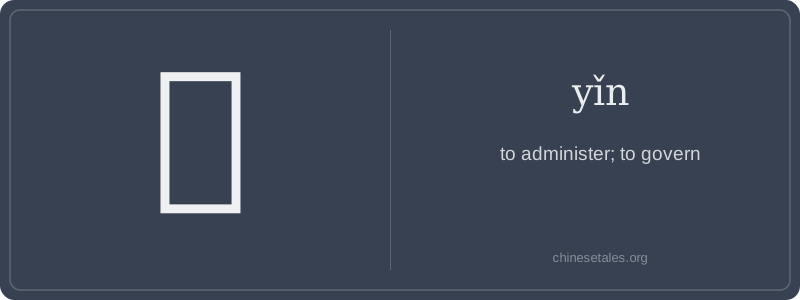
The earliest oracle bone inscriptions show 尹 as a simple yet powerful pictograph: a vertical line (丨) representing a staff or scepter, crossed near the top by a short horizontal stroke (一), all enclosed within a curved outline resembling a kneeling figure’s torso and arms — not a corpse, but a person *holding authority upright*. Over time, the kneeling shape simplified into the 尸 radical (a stylized upper body facing left), while the central strokes hardened into the modern 丿 and 乛 — still echoing that original gesture of control: a hand guiding the scepter downward to administer.
By the Western Zhou period, 尹 had crystallized as both a verb (‘to govern’) and a prestigious noun-title — most famously 令尹, the highest civil office in the state of Chu, held by figures like the philosopher Guan Zhong. In the *Zuo Zhuan*, 尹 appears repeatedly in contexts of ritual precision and administrative duty: ‘尹兹东土’ (‘He administers this eastern region’) — where 尹 conveys solemn stewardship, not conquest. The character’s visual economy — just four strokes — mirrors its semantic weight: minimal form, maximal responsibility. Even today, its shape whispers ancient protocol: authority exercised not from above, but from attentive presence.
尹 (yǐn) is one of those ancient, elegant characters that feels less like a word and more like a title whispered in court — it carries the quiet authority of administration, not brute force. Its core meaning isn’t ‘to rule’ like 王 (wáng, king), but ‘to govern with hands-on oversight’: to manage, direct, or preside, especially in official or ritual contexts. Think of a minister adjusting ceremonial robes, supervising rites, or overseeing granaries — not commanding armies, but ensuring order flows smoothly.
Grammatically, 尹 rarely appears alone in modern speech; it’s almost always embedded in compound nouns (like 令尹 or 京尹) or used as an archaic verb in literary or historical texts. You won’t say ‘I yǐn this project’ — instead, you’ll encounter it in classical-style phrases like ‘尹政’ (yǐn zhèng, ‘to administer governance’) or in proper names (e.g., the surname Yǐn). Learners often mistakenly treat it as a general synonym for ‘manage’ (管理 guǎnlǐ) — but 尹 implies formality, hierarchy, and antiquity; using it casually sounds like quoting Confucius at a coffee meeting.
Culturally, 尹 evokes Zhou-dynasty bureaucracy: it was the title of high-ranking ministers who governed regional capitals (e.g., 令尹 lìng yǐn, chief minister of Chu). Today, it survives mostly in surnames, historical terms, and poetic diction. A common pitfall? Misreading its radical 尸 (shī, ‘corpse’) as ominous — but here it’s purely phonetic and structural; the character’s authority comes from its top stroke (a stylized hand or scepter), not death. Its rarity outside classical contexts makes it a subtle marker of linguistic sophistication.