尰
Character Story & Explanation
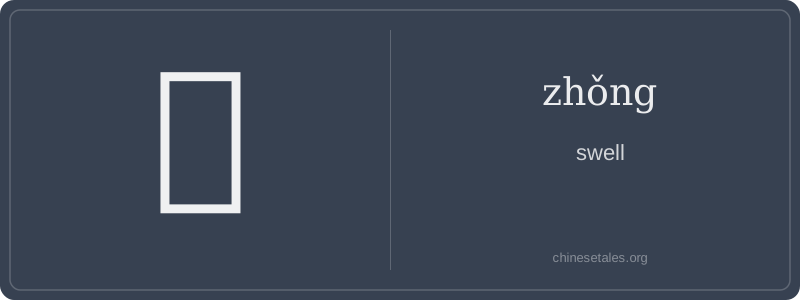
The earliest form of 尰 appears in bronze inscriptions as a pictograph combining 肉 (flesh, later radical 月) with 張 (zhāng, 'to stretch/tense') — not as a standalone glyph, but embedded in compound characters describing bodily distortion. Over centuries, the left side standardized into the 月 (moon/flesh) radical, while the right evolved from 張’s complex form into the simplified 章-like structure we see today: 月 + 章. Crucially, the top stroke of 章 was once a clear 'bow' shape — evoking tension, like stretched sinew — and the bottom 'ten' (十) and 'early' (早) components fused into a compact, angular signature that feels both rigid and swollen.
This visual tension mirrors its semantic journey: from early Zhou texts describing battlefield injuries ('his thigh 尰 to the size of a gourd'), through Han medical classics diagnosing 'wind-induced 尰', to Tang poetry using 尰 as a metaphor for moral or political bloating — 'the court’s corruption 尰 beyond measure'. Its meaning never softened; instead, it grew more precise, narrowing to pathological, persistent swelling — especially of limbs — distinguishing it from transient or cosmetic puffiness. Even in the Kangxi Dictionary (1716), 尰 is defined with clinical gravity: 'swelling due to obstruction of qi and blood, manifesting as hardness and heat.'
Imagine you’re hiking in the mountains of ancient China when suddenly your ankle swells up — hot, tight, and throbbing. A local herbalist examines it and says, 'Zhǒng! It’s 尰 — not just any swelling, but a deep, pathological, often chronic one, usually from injury or illness.' That’s 尰 in action: it’s not the casual puffiness of a mosquito bite (that’s 肿, zhǒng, same sound but different character!) — 尰 carries an archaic, clinical weight, like a term your grandfather’s physician might have used while consulting a Tang-dynasty medical scroll.
Grammatically, 尰 is almost exclusively a verb meaning 'to swell pathologically' or a noun meaning 'a pathological swelling', and it appears almost never in modern spoken Mandarin — you’ll find it only in classical texts, traditional medicine manuals, or highly literary descriptions. You won’t say '我的手尰了' in daily speech; you’d say '我的手肿了'. Using 尰 incorrectly sounds like quoting a 12th-century apothecary at a coffee shop — charming, but baffling.
Culturally, 尰 is a linguistic fossil — preserved in phrases like 尰瘇 (zhǒng zhǒng), where it doubles for emphasis, or in compound terms with 風 (wind) or 濕 (dampness) in TCM theory. Learners’ biggest mistake? Confusing it with 肿 (also zhǒng) — visually similar, same pronunciation, but 肿 is the living, breathing, HSK-irrelevant-yet-ubiquitous modern character. 尰 is its solemn, ink-stained ancestor — rarely seen, never casual.