尨
Character Story & Explanation
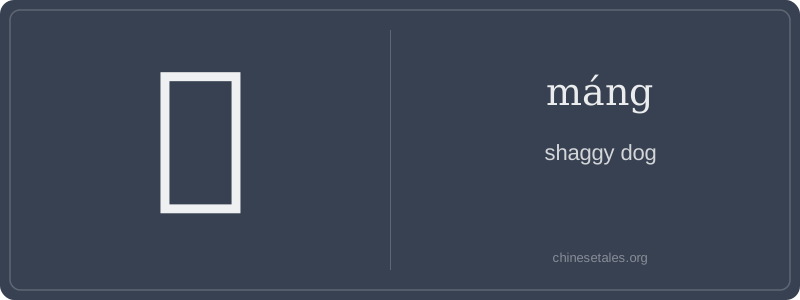
The earliest form of 尨 appears in bronze inscriptions from the Western Zhou dynasty (c. 1046–771 BCE), where it was written with a simplified 犬 (dog) radical on the left and a distinctive, jagged right-hand component resembling tangled fur or bristling hair — possibly drawn as three uneven strokes radiating outward, mimicking windblown strands. Over centuries, the right side evolved into the modern 亡 (wáng, to perish), but this wasn’t semantic — it was purely phonetic borrowing. The original pictograph was unmistakably zoomorphic: a dog with exaggerated, tousled coat, its silhouette deliberately rough and energetic.
By the Han dynasty, 尨 had solidified as a literary term for dogs whose coarse, thick fur gave them a rugged, almost heroic presence — unlike sleek hunting hounds or lap dogs. It appears in fragments of the *Shījīng* (Classic of Poetry) and later in Tang-era travel diaries describing frontier villages where such hardy dogs guarded sheepfolds. The character’s visual ‘roughness’ — seven strokes that feel hurried and textured — mirrors its meaning: not perfection, but resilient, earthy life. Even today, when a writer uses 尨, they’re invoking that ancient sensory memory — the sound of wind through stiff fur, the scent of damp wool and dust.
At first glance, 尨 (máng) feels like a linguistic fossil — it’s not in the HSK, rarely heard in daily speech, and almost never used alone. But that’s precisely what makes it fascinating: it’s a poetic, literary relic that evokes a very specific image — not just any dog, but a shaggy, unkempt, almost mythic canine, with fur so wild it blurs the line between animal and storm cloud. In classical Chinese, 尨 carried connotations of untamed vitality and rustic authenticity; think of a loyal but rough-hewn farm dog bounding across misty hills in a Tang poem — not a pampered Pomeranian.
Grammatically, 尨 functions almost exclusively as a noun, typically appearing in compound words or descriptive phrases. You’ll almost never see it in modern spoken Mandarin, but you *will* encounter it in classical allusions, poetry anthologies, or stylized writing — often paired with characters like 犬 (quǎn, dog), 狗 (gǒu, dog), or 鬃 (zōng, mane). Learners sometimes mistakenly treat it as a verb or try to use it colloquially (e.g., 'my dog is máng!'), but it doesn’t work that way — it’s an aesthetic descriptor, not a state-of-being.
Culturally, 尨 reveals how Chinese has long prized precise, evocative vocabulary for natural phenomena and animals — even when those words fall out of common use. It’s a reminder that meaning isn’t just about utility, but texture and tradition. A common mistake? Confusing it with 矛 (máo, spear) or 茫 (máng, vague) due to similar pronunciation — but visually and semantically, they’re worlds apart. Pronunciation note: while máng is standard for ‘shaggy dog’, páng appears only in extremely rare phonetic transcriptions or archaic dialect variants — ignore it unless reading pre-Qin bamboo slips.