尥
Character Story & Explanation
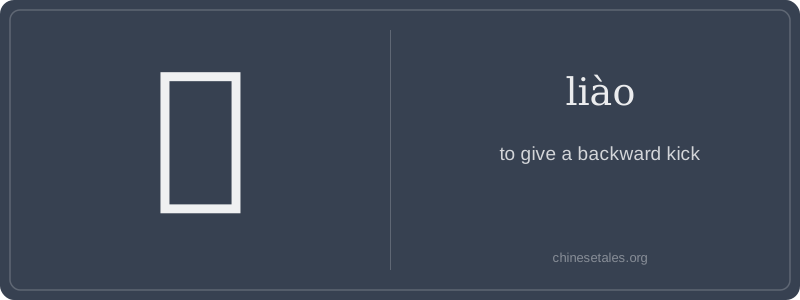
The earliest trace of 尥 appears not in oracle bone script but in late Ming dynasty vernacular manuscripts, where it emerged as a phonetic-semantic compound. Its left side 尢 (yóu) is the ‘limb’ or ‘leg’ radical — historically depicting a person with a bent leg or deformity, later generalized to movement-related meanings. The right side 辽 (liáo) was borrowed purely for sound (liào → liáo), but visually suggests ‘far’ or ‘vast’ — perhaps hinting at the *reach* of that powerful backward kick. Stroke by stroke: dot (丶) starts the radical, then the bent-leg shape (尢), followed by the three strokes of 辽’s simplified right component (冖 + 丿 + 丶), totaling six clean, angular strokes.
By the Qing dynasty, 尥 solidified in texts describing equestrian behavior — especially in military manuals and travelogues about northern frontiers where horseback riding was essential. It appears in Pu Songling’s *Strange Tales* (《聊斋志异》) to depict a possessed mule violently rejecting its rider — the character’s visual sparseness mirrors the abrupt, unmediated force of the act. Unlike elegant literary verbs, 尥 never became ‘refined’; its very shape — lean, sharp, slightly off-balance — preserves the moment of recoil.
Imagine a horse suddenly, defiantly, kicking backward — not just any kick, but one charged with rebellion, surprise, or raw animal energy. That’s 尥 (liào) in a nutshell: a vivid, onomatopoeic verb meaning *to give a sharp backward kick*, almost always by a horse or donkey. It’s not abstract or polite — it’s visceral and kinetic. You’ll rarely see it in formal writing; instead, it lives in regional speech (especially northern dialects), folk tales, and descriptive storytelling where movement matters more than grammar.
Grammatically, 尥 is an intransitive verb — it doesn’t take a direct object. You say ‘马尥了蹶子’ (the horse kicked back), not ‘尥它’. It often appears in the reduplicated form 尥蹶子 (liào juě zi), where 蹶子 means ‘kick’ — making the phrase literally ‘to kick-kick’, emphasizing suddenness and repetition. Learners sometimes mistakenly treat it as transitive or try to use it for humans (e.g., ‘他尥了一脚’), but that’s unnatural — humans *kick* (踢), horses *尥*.
Culturally, 尥 carries rustic charm and a touch of unruliness — think stubborn mules in rural China refusing to move, or cartoonish exaggeration in oral storytelling. It’s absent from HSK because it’s too colloquial and regionally rooted, yet it appears in classic vernacular novels like *The Scholars* (《儒林外史》) to highlight character temperament. A common mistake? Confusing it with 撂 (to lay down) — same sound, totally different action and radical!