尜
Character Story & Explanation
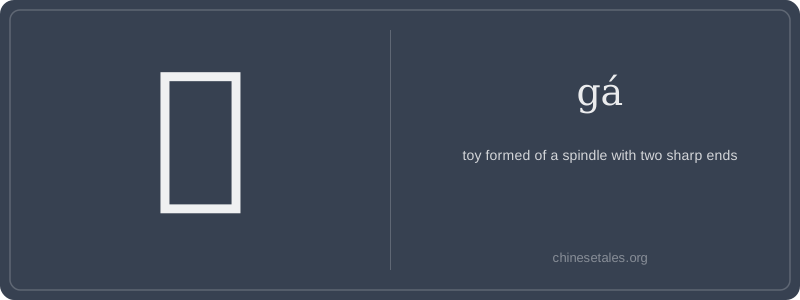
The earliest trace of 尜 appears not in oracle bones, but in late Ming–early Qing vernacular manuscripts and children’s rhyme books, where it was drawn as a simplified pictograph: two sharp points (the top and bottom dots) flanking a central vertical line — representing the spindle’s axis — with three short horizontal strokes suggesting rotation or balance. Over time, scribes streamlined it: the top dot fused into a tiny ‘small’ (小) radical, while the lower part evolved from 丫 (yā, ‘forked’) into the current form, preserving the dual-pointed, symmetrical essence. Its nine strokes aren’t arbitrary — they visually echo the spindle’s symmetry: small (3 strokes) + 丫 (6 strokes) = balanced duality.
By the Qing dynasty, 尜 had solidified as a phonetic-ideographic hybrid: the 小 radical hints at diminutive scale (a child’s toy), while the 丫 component evokes bifurcation — two sharp ends. Classical texts avoid it (too folksy), but it thrives in folk literature: the 18th-century nursery rhyme collection *Yǒuqíng Gēyáo* (‘Affectionate Rhymes’) uses 尜尜 to mimic the ‘click-click’ of spindles striking stone. Even today, elders in Shandong and Hebei still say ‘gá gá’ while demonstrating the toy — proving that some meanings live not on paper, but in finger-tips and laughter.
Let’s be honest: 尜 (gá) is a delightful oddball — it’s not in the HSK, rarely appears in modern texts, and yet it’s *perfectly* Chinese in its quiet specificity. It doesn’t mean ‘toy’ broadly — it names one precise, tactile object: a wooden spindle with two sharp, pointed ends, spun like a top or flicked between fingers for play. Think of it as ancient China’s fidget spinner — handmade, kinetic, slightly dangerous. The feeling? Playful but precise, rustic but technical. You’ll almost never see it used alone; it lives inside compound words (like 尜尜 or 尜尜尜), where repetition mimics the spinning motion itself.
Grammatically, 尜 is almost always reduplicated — 尜尜 (gá gá) or even 尜尜尜 (gá gá gá) — functioning as an onomatopoeic noun or playful verb. It’s not a standalone subject or object in formal writing; it’s oral, colloquial, and deeply tied to childhood memory or regional dialects (especially Northern Mandarin). Learners might try to use it like a regular noun (e.g., ‘I have a 尜’), but that sounds unnatural — it’s always embedded in rhythm, sound, and repetition.
Culturally, 尜 carries the warmth of handmade play before plastic existed. It’s nostalgic, sometimes poetic — you’ll find it in folk songs or grandparents’ stories, not textbooks. A common mistake? Pronouncing it as ‘jiā’ (confusing it with 加) or misreading the radical as something grander than 小 (‘small’). Remember: this character *is* small — both in stroke count (9) and cultural footprint — but its charm lies precisely in that humble, twirling specificity.