尙
Character Story & Explanation
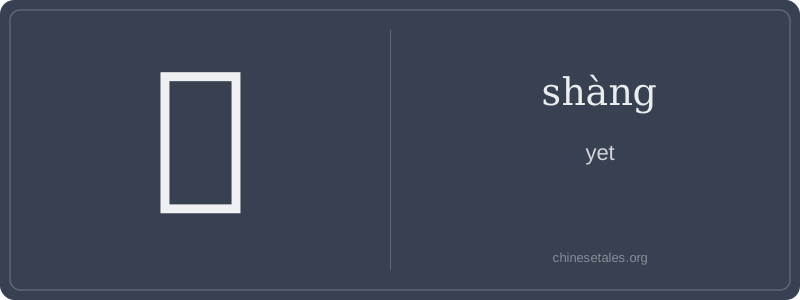
The earliest form of 尚 appears on Western Zhou bronze inscriptions as a compound pictograph: a standing figure (大) beneath a roof-like canopy (冂), with a small mark (often interpreted as a ritual offering or symbolic ‘head’) above — suggesting someone ‘up under the roof,’ i.e., elevated, esteemed, or present before authority. Over centuries, the top simplified into the radical 小 (a visual echo of the original ‘small object above’), while the lower part evolved from 大 to the current 尢-like shape (a stylized human figure), yielding the modern 8-stroke structure we see today.
This evolution mirrors a semantic shift: from ‘being present before superiors’ (a ritual posture of respect) → ‘still present/awaiting’ → ‘still not yet (in action)’ — retaining its air of deference and restraint. In the Book of Documents (Shūjīng), 尚 appears in phrases like ‘尚克時忱’ (‘may you still uphold timely sincerity’), where it underscores enduring virtue. Its visual humility — a ‘small’ element atop a grounded form — quietly enacts its meaning: modesty in expectation, dignity in delay.
‘Shàng’ (尚) doesn’t mean ‘yet’ in the simple, temporal sense like ‘not yet finished’ — it’s far more elegant and literary. It conveys a quiet, almost reverent sense of ‘still not,’ carrying undertones of expectation, patience, or even moral anticipation: as if something worthy is *still awaited*, not just delayed. You’ll rarely hear it in casual speech — it lives in formal writing, classical allusions, and bureaucratic documents, where its tone adds gravity and refinement.
Grammatically, 尚 functions as an adverb before verbs or adjectives, often paired with negation (e.g., 尚未, 尚无, 尚不). Crucially, it’s never used alone — unlike ‘yǐjīng’ (already) or ‘hái’ (still), 尚 always appears in compounds. Learners mistakenly try to say ‘wǒ shàng méi qù’ — but that’s unnatural; the correct form is ‘wǒ shàng wèi qù’. Omitting the bound morpheme (like 未 or 不) makes the sentence sound archaic or incomplete.
Culturally, 尚 reflects the Chinese value of measured anticipation — think of waiting for spring’s first plum blossom, or for a scholar’s official appointment after decades of study. It’s not passive waiting; it’s active, dignified expectancy. A common error is overusing it thinking it sounds ‘more Chinese’ — but native speakers reserve it precisely *because* it’s ornamental. Misplace it, and your sentence gains unintended solemnity, like bowing deeply at a coffee shop.