尕
Character Story & Explanation
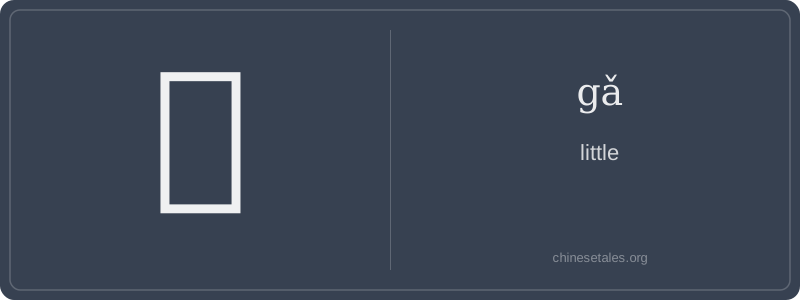
The character 尕 has no oracle bone or bronze script origin — it’s a latecomer, born in the Ming–Qing era as a phonetic-semantic compound. Its left side 小 (xiǎo, 'small') acts as the semantic hint, while the right side 乃 (nǎi, archaic 'then, thus') was borrowed purely for sound — but twisted! In Northwest dialects, 乃 was pronounced closer to *gǎ* (via nasalization and tone shift), making it a clever local phonetic stand-in. Visually, it’s minimalist perfection: just five strokes — two dots (small), a slanted stroke (the top of 小), then 乃’s hook-and-dot — forming an elegant, compact glyph that literally looks 'smaller than small'.
This character didn’t appear in classical texts — Confucius never wrote 尕. Instead, it bloomed in Qing dynasty folk songs, local operas, and Muslim Hui wedding verses across Gansu. Its meaning stayed remarkably stable: always 'little', always affectionate, always intimate. The visual economy — only five strokes for such rich feeling — mirrors the sparse beauty of the Loess Plateau itself: unadorned, resilient, and full of quiet warmth. Even today, elders in Lanzhou might write 尕 on red paper for baby blessings — not as calligraphy, but as a spoken charm made visible.
Think of 尕 (gǎ) as Chinese’s affectionate whisper — not the formal 'xiǎo' (small), but the warm, folksy, almost musical word for 'little' you’d use when pinching a child’s cheek or calling your grandma in Qinghai. It’s not standard Mandarin; it’s a regional treasure from Northwest China (Gansu, Qinghai, Ningxia), deeply embedded in the local dialects and ethnic interactions — especially between Han, Hui, and Tibetan communities. You’ll hear it in terms like 尕娃 (gǎ wá, 'little kid') or 尕脸蛋 (gǎ liǎn dàn, 'rosy little cheeks'), always carrying tenderness, familiarity, or gentle teasing.
Grammatically, 尕 functions almost exclusively as a diminutive prefix — never standalone, never in formal writing, and never in verbs or adjectives. It attaches directly to nouns (e.g., 尕狗 gǎ gǒu — 'pup'), often replacing or softening 小. Crucially: it’s not interchangeable with 小 in Standard Mandarin — saying *‘gǎ shū’ instead of ‘xiǎo shū’ will instantly mark you as a local or someone who’s spent real time in the Hexi Corridor. Learners sometimes mistakenly use it in Beijing speech or try to write it in essays — big no-no! It’s oral, regional, and deeply contextual.
Culturally, 尕 is linguistic gold dust: a living fossil of Northwest Sinitic + Amdo Tibetan contact. Its pronunciation (gǎ) likely evolved from Tibetan *ga* ('small, young') via centuries of bilingual trade and kinship. Mistake it for a typo? You’ll miss its emotional resonance — that slight guttural catch on the 'g' mirrors the high-altitude air of the Qinghai-Tibet Plateau. And yes, it’s missing from the HSK list not because it’s rare, but because it’s too local to be standardized — yet it’s heard daily by over 10 million people.