尐
Character Story & Explanation
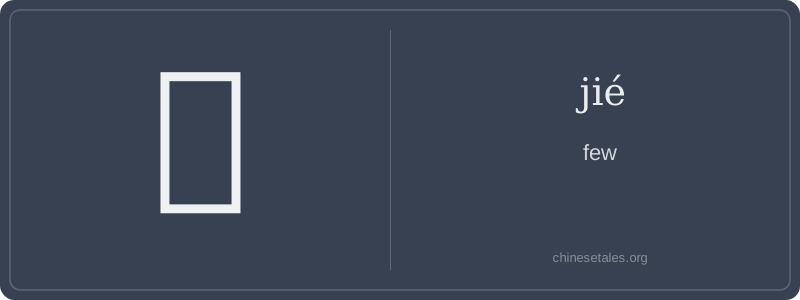
Look closely at 尐: just three strokes — a downward left stroke (丿), then two short diagonal strokes (⺄). But its oracle bone origins are even sparser: early forms were minimalist pictographs resembling three tiny, scattered dots or pebbles — not counting objects, but visually suggesting 'scarcity through sparseness'. Over time, scribes stylized those dots into angular strokes, merging them into the compact, top-heavy shape we see today. The radical 丿 (piě) — the 'left-falling stroke' — isn’t decorative; in ancient script theory, it often signals movement or diminution, reinforcing the idea of things 'falling away' or 'being few'.
This character first appeared in bronze inscriptions of the Western Zhou dynasty (c. 1046–771 BCE), where it modified nouns to express 'a scant amount' — e.g., 尐言 ('few words'), implying restraint or humility. By the Han dynasty, it was already fading from active use, preserved mostly in rhyme dictionaries like the Qièyùn (601 CE) as a phonetic-semantic unit. Its visual economy — minimal strokes encoding maximal conceptual lightness — made it elegant but impractical. Confucian scribes preferred the more robust, versatile 少; 尐 remained a scholar’s footnote: beautiful, precise, and quietly obsolete.
Let’s get one thing straight: 尐 (jié) is a linguistic ghost — it exists in dictionaries, appears in classical texts, and even has its own radical (丿), but you’ll almost never hear it spoken or see it written in modern Chinese. Its core meaning is 'few' or 'small in number', but unlike common synonyms like 少 (shǎo) or 微 (wēi), 尐 carries an archaic, literary weight — think of it as the Mandarin equivalent of saying 'methinks' instead of 'I think'. It’s not about quantity alone; it evokes scarcity with a quiet, almost poetic gravity.
Grammatically, 尐 functions as an adjective or adverb — but only in highly formal or classical constructions. You won’t find it in 'I have few friends' (that’s 少); instead, it appears in phrases like 尐有 (jié yǒu, 'has few') in historical records or pre-modern poetry, often paired with verbs to imply rarity or modesty of occurrence. A classic trap? Learners sometimes misread it as 少 because of visual similarity — but 少 is everyday, neutral, and grammatically flexible; 尐 is frozen in time, rarely used independently, and almost always embedded in compound words or fixed expressions.
Culturally, 尐 is a relic of Old Chinese phonology and orthography — it survives mainly in specialized lexicography and paleographic study. Its near-total absence from spoken language and modern media means encountering it feels like unearthing a character fossil. Even native speakers may pause and squint at it. That’s why it’s not in the HSK: it’s less a tool for communication than a window into how Chinese script once encoded subtle semantic distinctions — distinctions that later simplified or vanished.