尌
Character Story & Explanation
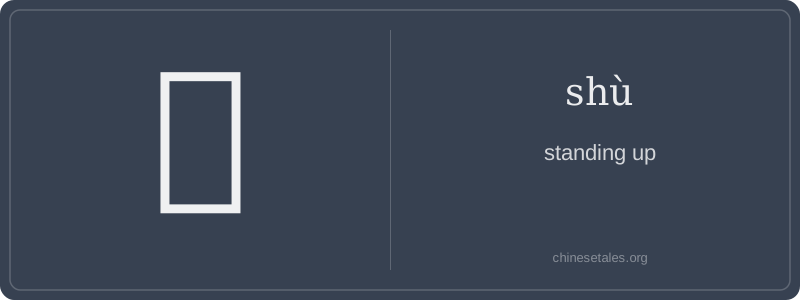
Carved over 3,000 years ago on oracle bones, 尌 began as a vivid pictograph: a single upright line (丨) representing a human figure standing firm, flanked by two symmetrical arms (like ⺅ shapes) raised slightly — not waving, but *holding position*. Below, a stylized foot (止) anchored it to earth. Over centuries, the arms simplified into the left-side component (尌’s top-left), the foot fused with the bottom stroke, and the inch-radical (寸) was added later — not as a unit of measure, but as a seal of *intentional, calibrated establishment*, reflecting how ritual objects were placed 'exactly one inch' from sacred markers in Zhou dynasty ceremonies.
This visual logic shaped its meaning: 尌 wasn’t just 'standing' — it was *ritual erection*, like setting up an ancestral tablet or raising a boundary stone. In the *Book of Rites* (Lǐjì), 尌 appears in descriptions of state ceremonies where ministers '尌表' (shù biǎo, 'erect markers') to define sacred space. Its form — balanced, vertical, grounded — became synonymous with moral rectitude: just as the character stands unwavering on the page, so must the virtuous person stand unswayed by temptation. Even today, calligraphers emphasize its vertical center stroke — the 'spine' that holds the entire structure upright.
Forget 'standing up' as a physical action — 尌 (shù) is all about *upright presence*: the quiet authority of something planted firmly, unshakably vertical. Think less 'jumping to your feet' and more 'a scholar standing tall in court', or 'a pillar holding up heaven'. It’s not a verb you’d use in daily chat; it’s archaic, literary, and carries weight like carved jade — elegant but rare. You’ll find it mostly in classical texts, poetry, or compound words where 'uprightness' is moral or structural.
Grammatically, 尌 functions almost exclusively as a verb meaning 'to set up', 'to establish', or 'to erect' — always with intention and permanence. It never appears alone in modern speech. Instead, it hides inside compounds like 樹立 (shùlì, 'to establish') or 立尌 (lìshù, 'to set upright'). Learners often misread it as 樹 (shù, 'tree') due to identical pronunciation and shared radical — but 尌 has no botanical meaning! Confusing them turns 'establishing virtue' into 'planting a tree' — a charming but catastrophic mix-up.
Culturally, 尌 embodies Confucian ideals of moral steadfastness: just as a pillar must be perfectly vertical to bear weight, a person must be morally upright to uphold society. It appears in phrases like 尌德 (shù dé, 'to establish virtue'), echoing ancient rites where rulers erected ceremonial stelae to affirm legitimacy. Modern learners rarely encounter it solo — which is why mistaking its radical (寸, 'inch') for a mere measurement clue is common. But 寸 here signals *deliberate, measured placement* — not length, but precision of stance.