寰
Character Story & Explanation
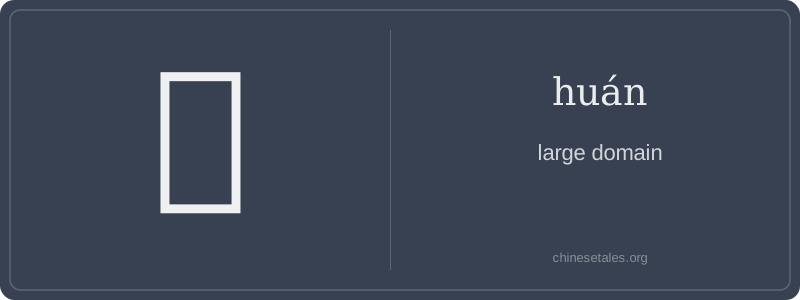
The earliest form of 寰 appears in bronze inscriptions as a combination of 宀 (roof/heavenly canopy) over 奐 (a variant of 焕, meaning ‘brilliant’ or ‘radiant’), but crucially — it evolved from a pictograph showing a jade bi disc (璧), a ritual object symbolizing heaven, enclosed beneath a roof-like stroke. Over centuries, 奐 simplified into 蜂 (fēng, bee) then further stylized into the modern upper-right component, while the central ‘circle’ (originally a full ring) became the angular ‘巳’-like shape we see today — still echoing the perfect, encompassing roundness of the heavens.
This visual logic shaped its meaning: the roof (宀) signifies celestial authority and shelter; the inner form represents the complete, ordered sphere governed beneath it — hence ‘the entire domain under heaven’. In the Zuo Zhuan, it appears in phrases like ‘普天之下,莫非王土;率土之滨,莫非王臣’ — and 寰 later crystallized that idea into a single glyph. By the Tang dynasty, poets like Li Bai used 寰宇 to evoke awe at cosmic scale, cementing its role as the written embodiment of unified, harmonious totality — not mere size, but sacred wholeness.
‘寰’ isn’t just ‘large domain’ — it’s the ancient Chinese cosmos in a single character: the boundless, concentric sphere of heaven and earth, imagined as a jade disc (the ‘circle’ component) under the sheltering roof of heaven (the 宀 radical). It carries poetic gravity, evoking imperial geography, cosmic order, and literary grandeur — think ‘all under heaven’ but with celestial precision. You’ll almost never hear it in daily speech; it lives in formal writing, historical texts, and set phrases like 寰宇 (huán yǔ, ‘the whole universe’) or 九寰 (jiǔ huán, ‘the nine realms’ — a classical term for the civilized world).
Grammatically, 寰 is strictly a noun or attributive noun — never a verb or standalone adjective. Learners sometimes try to use it like ‘world’ in casual contexts (e.g., *‘this restaurant is popular in 寰’), but that’s jarring and ungrammatical. It only appears in fixed compounds or literary appositions: ‘寰内’ (within the realm), ‘寰中’ (within the celestial sphere), always paired with another noun or preposition. Its tone (huán, second tone) rhymes with ‘swan’ — a subtle cue to its soaring, elegant register.
Culturally, 寰 reveals how early Chinese cosmology fused geography, astronomy, and political philosophy: the emperor ruled not just land, but the harmonious sphere where heaven, earth, and humanity intersected. Modern learners often misread it as ‘huan’ meaning ‘to circle’ (like 环 huán), but 寰 has zero connection to verbs — it’s purely spatial and sacred. Confusing it with 环 is the #1 error, leading to unintended circularity instead of cosmic scope.