寮
Character Story & Explanation
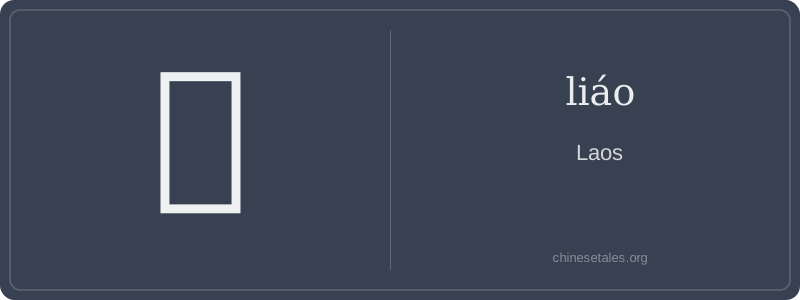
The earliest form of 寮 appears in late Warring States bronze inscriptions as a compound of 宀 (a stylized roof) over 尞 — itself derived from oracle bone script depicting a tall platform (丿+兀) with flames (火) rising vertically, symbolizing a ceremonial fire tower used to summon spirits or mark territory. Over centuries, the fire element simplified into the two diagonal strokes and dot in 尞’s upper right, while the platform became the horizontal and vertical lines beneath. By the Han dynasty clerical script, the structure solidified: 宀 firmly crowning the now-abstracted 尞, losing its fiery pictorial clarity but gaining phonetic stability.
This evolution mirrors its semantic journey: from a concrete image of ritual sovereignty → a phonetic signifier for ‘Lao’ → a politically weighted toponym. Unlike most place-name characters (e.g., 法 for France, 德 for Germany), 寮 was coined in the early 20th century specifically for Laos — not borrowed from ancient texts. Yet its components root it deeply in classical semantics: 宀 signals ‘a people under one roof’, while 尞, also found in 燎 (liáo, ‘to ignite’) and 嘹 (liáo, ‘loud’), carries connotations of visibility and resonance — fitting for a nation asserting its identity on the regional stage.
Let’s unpack 寮 (liáo) like a linguistic archaeologist: it’s a rare, formal character used almost exclusively as the official Chinese name for Laos — not the everyday word (that’s 老挝, lǎo wō), but the solemn, treaty-level designation you’ll see in diplomatic documents, UN reports, and academic geography. Visually, it’s built from 宀 (mián, ‘roof’ radical) on top — hinting at shelter, settlement, or a defined territory — and below, 尞 (liǎo), an ancient phonetic component that once depicted fire rising through a ritual tower (think: beacon, signal, sovereignty). So 寮 subtly evokes ‘a sovereign land under its own roof’ — poetic, political, and precise.
Grammatically, 寮 functions only as a proper noun, never as a verb, adjective, or standalone morpheme. You’ll never say *‘I 寮’ or ‘very 寮’ — it appears only in compounds like 寮國 (Liáo guó, ‘Laos’) or in fixed phrases like 中寮關係 (Zhōng Liáo guānxi, ‘China–Laos relations’). Learners sometimes mistakenly use it alone (e.g., *‘我去寮’), but that’s ungrammatical — always pair it with 國, 外交, or similar nouns. Also, avoid confusing it with the common word 僚 (liáo, ‘colleague’), which shares pronunciation but has zero semantic connection.
Culturally, 寮 reflects China’s historical naming conventions for neighboring states: characters were chosen for phonetic approximation *and* auspicious meaning — here, 尞 implies brightness and legitimacy. It’s so specialized that even many native speakers only recognize it from maps or news headlines. A frequent slip? Typing 寮 instead of 老 when texting casually — a tiny stroke difference (宀+尞 vs. 老+兀) that swaps a nation for… well, nothing, since 老 is just ‘old’. Precision matters — especially in diplomacy.