寨
Character Story & Explanation
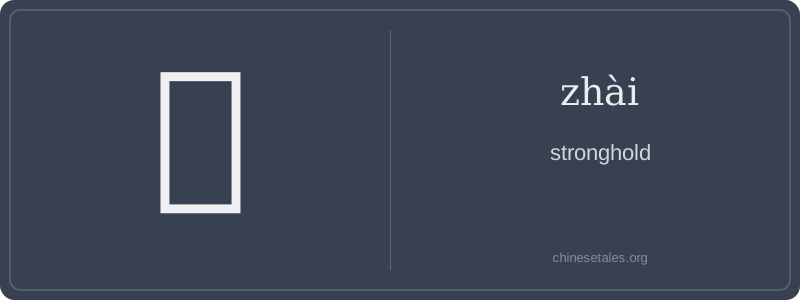
The earliest form of 寨 appeared in late Han and early Wei-Jin stele inscriptions — not oracle bones — as a compound ideograph: 宀 (mián, 'roof') at the top, symbolizing shelter or enclosure, fused with 艹 (cǎo, 'grass') above 木 (mù, 'tree') below, suggesting wooden palisades wrapped in thatch or wild vegetation. Over centuries, the grass radical simplified and merged with the tree component, evolving into the modern 罒 (a variant of 网, 'net') atop 木 — visually evoking a woven wooden barrier under a roof-like canopy. The stroke count (14) precisely preserves this layered structure: 3 for 宀, 5 for 罒, and 6 for 木.
This visual logic mirrors its semantic journey: from literal 'thatched-wooden stockade' in military manuals like the Song-era Wujing Zongyao, to the romanticized rebel bases of the Water Margin (where Liangshan is called 梁山泊寨), and finally to ethnolinguistic identity — today, 贵州苗寨 (Guìzhōu Miáozhài) isn’t just 'Miao fortress' but 'Miao communal homeland'. The character’s roof + net + tree composition still whispers: 'a living barrier — grown, not built; guarded, not occupied'.
At its heart, 寨 (zhài) evokes a place of strategic seclusion — not just any 'fort' or 'fortress', but one built with purposeful isolation: mountain-encircled, gate-barred, and community-governed. It carries the quiet authority of self-reliance, often implying resistance, autonomy, or frontier resilience — think bandit strongholds in classical novels or Miao ethnic villages perched on cliffs. Unlike generic terms like 城 (chéng, 'walled city') or 堡 (bǎo, 'fort'), 寨 feels earthy, tactical, and slightly romanticized by history.
Grammatically, 寨 functions almost exclusively as a noun — rarely a verb or adjective — and appears mostly in proper nouns (e.g., 水泊梁山寨, Shuǐbó Liángshān Zhài — 'Liangshan Marsh Stronghold') or compound words. Learners sometimes mistakenly treat it as a standalone verb ('to fortify!'), but it never conjugates — no 寨了, no 寨过. It’s also never used for modern military bases; that’s 军营 or 基地. Its usage is deliberately archaic or culturally specific.
Culturally, 寨 reflects how geography shaped Chinese social organization: rugged terrain demanded collective defense, turning villages into de facto strongholds — hence 寨 doubles as an ethnic village term (e.g., 苗寨 miáozhài, 'Miao village'). A common learner trap? Confusing it with 赛 (sài, 'competition') — same tone, similar sound, utterly unrelated meaning. Also, don’t expect to hear it in daily conversation; it lives in literature, tourism brochures, and ethnic minority contexts — a word you’ll read more than speak.