寙
Character Story & Explanation
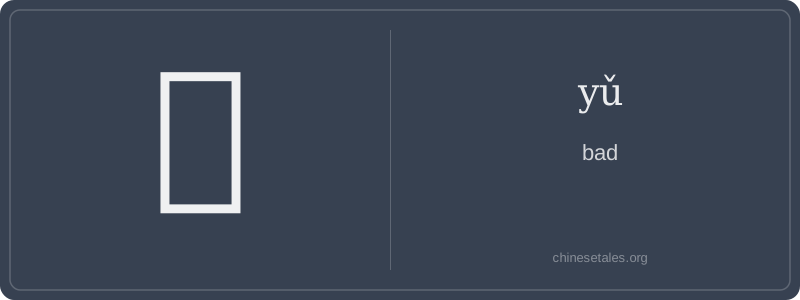
The earliest form of 寙 appears in late Warring States bamboo manuscripts — not oracle bones — as a compound ideograph: the top half is 宀 (mián), a roof symbolizing shelter or domain, and the bottom is 矢 (shǐ), an arrow. But here’s the twist: 矢 is drawn *upside-down*, with the arrowhead pointing downward *through* the roof — a shocking visual metaphor for violation, penetration of sacred space, or internal collapse. Over centuries, the inverted arrow simplified into the current 口-like shape beneath 宀, losing its literal arrowhead but preserving the sense of something ‘piercing inward’ — i.e., moral rot festering from within the household or self.
This image evolved into a philosophical shorthand: if 宀 represents the cultivated self or righteous order, then 寙 is what happens when that structure is pierced by base desire — hence ‘inherently corrupt.’ The Han scholar Xu Shen recorded it in the Shuōwén Jiězì (c. 100 CE) as ‘a person whose nature is fundamentally twisted,’ citing its use in the lost text Zhōu Shū to describe tyrants. Its rarity today isn’t neglect — it’s linguistic quarantine: too potent, too dark for daily use. Even in classical commentaries, scribes often substituted 惡 (è) to soften the blow.
Let’s get one thing straight: 寙 (yǔ) doesn’t mean ‘bad’ in the everyday sense — it’s not your go-to word for ‘bad weather’ or ‘bad idea.’ It’s a rare, archaic character that conveys moral corruption, spiritual decay, or profound degeneracy — think ‘rotten to the core,’ ‘morally bankrupt,’ or ‘inherently vile.’ Its tone is literary, almost biblical; you’ll find it in classical texts describing fallen rulers or corrupted virtue, not in modern texting. It carries visceral weight — less ‘oops’ and more ‘this dynasty is doomed.’
Grammatically, 寙 functions almost exclusively as an adjective, usually pre-nominally and often in parallel or contrastive structures (e.g., ‘正直与寙’ — ‘uprightness and depravity’). It rarely stands alone in speech and never takes aspect markers like 了 or 过. Learners sometimes mistakenly use it like 恶 (è, ‘evil’) or 坏 (huài, ‘bad’), but 寙 has zero colloquial usage — no native speaker says ‘这苹果寙了’ (‘this apple went bad’). That would sound like quoting a Ming-dynasty morality tract at a fruit stand.
Culturally, 寙 embodies Confucian anxiety about moral entropy — the idea that without constant cultivation, human nature slides into inherent baseness. It appears in Mencius debates about whether人性 (xìng, human nature) is inherently good or corruptible. Modern learners encounter it mostly in philology exams or Tang poetry footnotes. Mistake alert: its near-identical look-alike 富 (fù, ‘rich’) trips up beginners — same top, wildly different bottom and meaning. Remember: 寙 = yǔ = yuck, not wealth!