寘
Character Story & Explanation
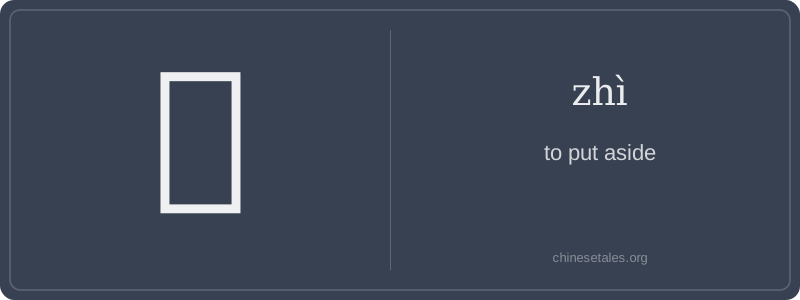
The earliest form of 寘 appears in Warring States bamboo slips as a compound ideograph: the top half was a variant of 宀 (mián, 'roof'), symbolizing a protected space, while the bottom was 廾 (gǒng, 'hands cupped together'), representing reverent handling. Over centuries, the roof evolved into the modern 宀 radical, and the hands simplified into the distinctive double-7 shape ( + ) beneath — not random strokes, but stylized, symmetrical gestures of respectful deposition. By the Han dynasty, clerks standardized it into today’s 10-stroke form, preserving the visual duality of shelter and care.
This character’s meaning deepened alongside China’s bureaucratic tradition: to 寘 something wasn’t just to store it — it was to assign it provisional status within an ordered hierarchy. The *Zuo Zhuan* uses 寘 when describing how Duke Huan ‘set aside’ a rival claimant — not imprisoning him, but placing him under watchful, temporary custody. The character’s balance — roof above, hands below — mirrors its philosophical function: containment without erasure, pause without rejection. Even today, when legal texts say ‘案情暂寘’, they’re invoking that ancient gesture: two hands, under shelter, holding time itself still.
Think of 寘 (zhì) as the Chinese equivalent of tucking a letter into a drawer labeled 'For Later' — not discarding it, not acting on it now, but deliberately setting it aside with quiet intention. Unlike common verbs like 放 (fàng, 'to put') or 放置 (fàngzhì, 'to place'), 寘 carries an archaic, almost ceremonial weight: it implies purposeful suspension, often in legal, literary, or bureaucratic contexts. You’ll rarely hear it in daily speech — it’s more at home in classical texts or formal documents than in a café order.
Grammatically, 寘 functions as a transitive verb, always taking a direct object, and is nearly always followed by a location complement (e.g., 寘之于案, 'set it upon the desk'). It doesn’t take aspect markers like 了 or 过 — its very form signals finality and deliberation. Learners mistakenly try to use it like 置 (zhì, 'to place') or even 搁 (gē, 'to put aside colloquially'), but 寘 resists casual usage; dropping it into modern conversation sounds like quoting a Ming-dynasty magistrate.
Culturally, 寘 evokes Confucian precision in ritual action — every placement matters. In the *Book of Rites*, objects are 寘 with exact orientation and sequence to maintain cosmic harmony. A common mistake is overgeneralizing from its phonetic similarity to 致 (zhì, 'to send/achieve') or 志 (zhì, 'aspiration'); none share its semantic core of *ritualized deferral*. If you imagine Chinese characters as historical documents, 寘 isn’t a sticky note — it’s a silk-bound edict sealed for future reading.