寔
Character Story & Explanation
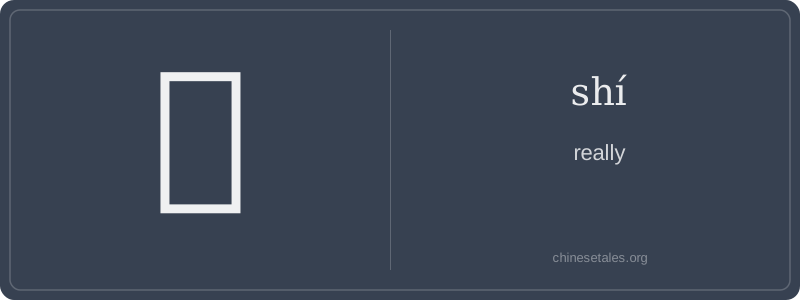
The earliest form of 寔 appears in Western Zhou bronze inscriptions (c. 1000 BCE) as a complex pictograph: a hand holding a ritual vessel (often interpreted as a tripod cauldron, 皿) placed atop a base representing earth or altar — symbolizing 'truth confirmed through proper offering and ritual correctness.' Over centuries, the vessel simplified into 宀 (roof), the hand became the left-side 亠 + 冖-like cover, and the base evolved into the bottom 宀 + 羊-like structure — eventually crystallizing into today’s 寔, where every stroke echoes ancestral accountability.
By the Warring States period, 寔 shifted from concrete ritual verification to abstract moral authenticity — appearing in texts like the *Book of Rites* (礼记) to stress sincerity in conduct: '君子之行,贵乎寔' ('A gentleman’s conduct values genuineness above all'). Its visual density — eight strokes packed with layered meaning — mirrors its semantic weight: no flourish, no ambiguity. Even today, calligraphers treat 寔 like a 'truth seal': its balanced yet grounded structure conveys unshakeable veracity — making it a favorite in mottoes carved above ancestral halls.
Let’s cut to the chase: 寔 (shí) isn’t a character you’ll see on modern menus, subway signs, or HSK flashcards — and that’s precisely what makes it fascinating. It means 'really', 'truly', or 'indeed', but with an old-soul weight: think Shakespearean 'verily' meets Confucian sincerity. It doesn’t float around like 好 (hǎo) or 很 (hěn); instead, it anchors solemn declarations — truth affirmed not by emotion, but by moral conviction. You’ll find it in classical texts, formal inscriptions, or poetic invocations where authenticity is non-negotiable.
Grammatically, 寔 functions as an adverb — always pre-verbal, never modifying nouns. Unlike 很 (which softens), 寔 intensifies *with authority*: 寔乃… ('Truly, this is…') signals irrefutable conclusion, not opinion. Learners often misplace it after verbs or try to pair it with colloquial particles like 啊 or 吧 — a fatal mismatch. Also, don’t confuse its tone: shí (second tone, rising), not shì (fourth tone, falling) — saying 'shì' accidentally evokes 是 (to be), derailing your whole sentence.
Culturally, 寔 carries the gravity of ancient verification — like stamping a seal on a contract carved in jade. In imperial edicts or bronze inscriptions, it wasn’t filler; it was a vow written into cosmology. Modern learners rarely need it for daily chat, but spotting it in calligraphy, temple plaques, or scholarly essays unlocks a deeper layer of Chinese rhetorical tradition — where truth isn’t asserted, it’s *attested*.