寐
Character Story & Explanation
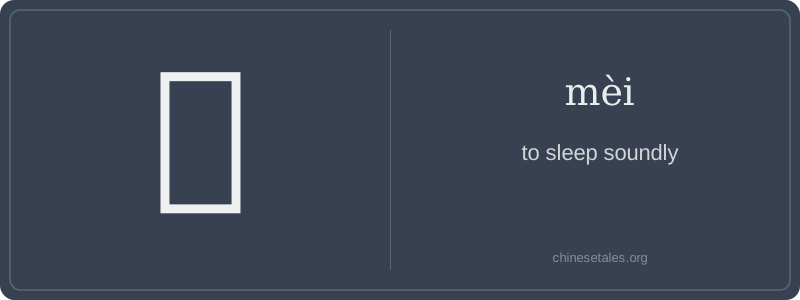
The earliest form of 寐 appears on Warring States bamboo slips as a roof (宀) sheltering a person lying down (the precursor to 未), with a hand holding a weapon-like stroke (殳) — not for violence, but to suggest *stillness enforced*, like a guard ensuring no disturbance. Over centuries, the lying figure simplified into 未 (wèi), while 殳 (shū), originally a ceremonial staff or club, evolved into a stylized ‘hand-and-strike’ component symbolizing *the cessation of all action*. By the Han dynasty, the structure stabilized: 宀 (roof/home) + 未 (not yet upright — i.e., prone) + 殳 (the act of laying down completely).
This visual logic cemented its meaning: not just sleeping, but *sleep so deep that consciousness, movement, and even time dissolve*. In the Classic of Poetry (Shījīng), we read ‘辗转反侧,寤寐思服’ (zhuǎn zhuǎn fǎn cè, wù mèi sī fú) — ‘tossing and turning, awake and asleep, I yearn for you’ — where 寐 contrasts sharply with 寤 (wù, waking), framing sleep as an immersive, emotional state. Even today, the character’s three-part composition whispers: under shelter, body still, mind surrendered.
Forget 'to sleep' — 寐 (mèi) is specifically about sinking into deep, undisturbed, almost sacred slumber. It’s not the light doze of 午睡 (wǔshuì) or the restless tossing of 难眠 (nán mián). Think of a scholar exhausted after midnight study, or a child breathing evenly under moonlight: 寐 evokes stillness, surrender, and profound peace. You’ll rarely hear it in casual speech — it’s literary, poetic, and often paired with words like ‘不’ (bù) or ‘难’ (nán) to stress the *absence* of such rest.
Grammatically, 寐 is almost always used as a verb in classical or semi-classical structures — frequently as the complement in phrases like ‘难以入寐’ (nán yǐ rù mèi, ‘hard to fall into deep sleep’) or ‘不能安寐’ (bù néng ān mèi, ‘unable to sleep peacefully’). It doesn’t take objects, and never appears in imperative or progressive forms (no *mèi-zhe* or *qǐng mèi!*). Learners sometimes mistakenly use it like 睡 (shuì), but saying ‘我寐了’ sounds like quoting a Tang dynasty poem — charming, but wildly out of place at dinner.
Culturally, 寐 carries quiet weight: in classical texts, failing to 寐 signals moral distress, grief, or scholarly anxiety — think of Confucius sighing in the Analects over ‘夜不能寐’. Modern usage preserves that gravity: news reports say ‘民众彻夜难寐’ (mínzhòng chèyè nán mèi) after disasters — not just ‘couldn’t sleep’, but ‘lay awake in anguished silence’. A common error? Writing 寐 with the wrong lower component (e.g., confusing it with 密 or 蜜) — remember: it’s 宀 + 未 + 殳, not 宀 + 秘!