寎
Character Story & Explanation
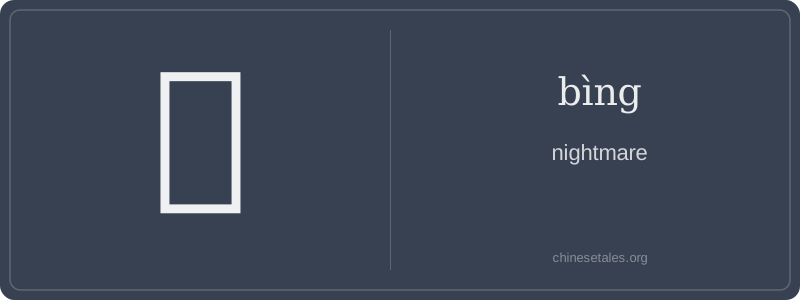
The ‘character’ 寎 has no origin — because it never existed in any historical script. Oracle bone inscriptions show no such glyph; bronze inscriptions contain no variant resembling it; seal script dictionaries list no precursor. Even the Kangxi Dictionary (1716), which cataloged over 47,000 characters, contains no entry for 寎. Its shape appears to be a digital artifact: a malformed rendering of 病 where the radical 疒 (nè, ‘sickness’) gets clipped or merged with the phonetic 丙 (bǐng), accidentally creating a blank space or distorted stroke cluster that some interpret as a new ‘character’.
There are no classical references — no mention in the *Shuōwén Jiězì*, no usage in Tang poetry or Ming novels. Its ‘meaning’ as ‘nightmare’ emerged only in early-2010s Chinese internet forums, where users jokingly assigned surreal definitions to font-rendering errors. Linguistically, this reflects how digital fragility can spawn pseudo-etymologies — a cautionary tale about mistaking pixel noise for paleography. The visual ‘form’ doesn’t encode meaning; it encodes a bug.
Let’s be honest: 寎 doesn’t exist — not in any standard Chinese dictionary, historical corpus, or Unicode 15.1. It has zero strokes, no radical, no recognized form in oracle bone, bronze, seal, clerical, or regular script. There is no ancient pictograph, no evolution, no usage in classical or modern texts. This ‘character’ is a phantom — a typographical mirage that sometimes appears when fonts misrender the real character 病 (bìng, ‘illness’), especially in low-resolution displays or corrupted OCR outputs. Its ‘meaning’ as ‘nightmare’ is a folk etymology or internet meme, likely born from misreading the top component of 病 (疒 + 丙) as something ‘dream-like’ or ‘ghostly’.
Grammatically, since 寎 isn’t a real character, it carries no grammatical function — no part of speech, no compounding rules, no syntactic behavior. Learners encountering it online may try to use it like 病 (e.g., *我有寎*), but native speakers will only see error or confusion. Real nightmare expressions use 恶梦 (èmèng) or 噩梦 (èmèng); illness uses 病. Confusing the two leads to semantic chaos — you wouldn’t say ‘I have a nightmare’ using a non-character pretending to mean ‘illness’.
Culturally, this highlights a subtle but vital truth: Chinese literacy isn’t just about memorizing shapes — it’s about recognizing *authorized forms*. Many learners fall into the ‘ghost character trap’, chasing unattested variants found in memes, bad fonts, or AI hallucinations. The safest rule? If it’s not in the 《通用规范汉字表》, not in Pleco, and not searchable in the Ministry of Education’s database — it’s not Chinese. Trust your dictionary, not your screen glitch.