寇
Character Story & Explanation
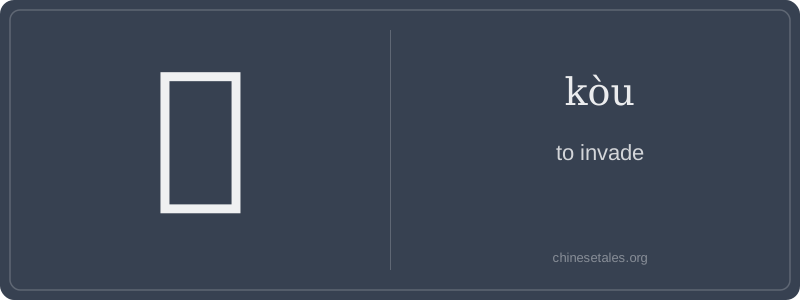
The earliest form of 寇 appears on Western Zhou bronze inscriptions as a vivid pictograph: a house (roof 宀) with an armed figure (represented by 攴 — a hand holding a striking tool) inside, and below, a person (元, later simplified to 元 → ⺗) — suggesting an intruder forcibly entering a dwelling. Over centuries, the ‘person’ element evolved into the top part of the modern 元, while the ‘striking hand’ (攴) became the right-side component. By the Small Seal Script, the structure stabilized into 宀 + 元 + 攴 — three elements telling one urgent story: danger under your roof.
This visual logic directly shaped its meaning: not mere 'arrival', but violent, unauthorized entry. In the Classic of Poetry (Shījīng), 寇 describes marauding tribes threatening Zhou settlements. Confucius used it morally in the Analects (16.1) warning rulers that misrule invites internal 寇 — i.e., rebellion born from injustice, not just foreign armies. So 寇 isn’t only about external enemies; it’s also about breaches of order — physical, political, even ethical — making its roof-and-weapon imagery profoundly symbolic.
At its heart, 寇 (kòu) isn’t just ‘to invade’ — it’s the visceral image of armed outsiders breaching the roof (宀) of your home or community. It carries weight, urgency, and historical gravity: this is not a casual border crossing but a hostile, organized incursion. In modern usage, it almost never appears alone as a verb — you won’t say ‘他寇了’ — instead, it lives in formal compounds like 入寇 (rù kòu, 'to invade') or as a noun meaning 'invader' or 'bandit', especially in historical or literary contexts.
Grammatically, 寇 functions mostly as a noun ('the invaders') or in fixed two-character verbs (e.g., 侵寇, qīn kòu). Learners often mistakenly try to use it like a regular action verb (e.g., *‘kòu jìn’ for ‘invade’), but that’s ungrammatical — the correct verb is 侵略 (qīn lüè) or 入侵 (rù qīn). Even native speakers rarely use 寇 outside set phrases or classical-style writing — think newspaper headlines about ancient wars or historical novels, not daily conversation.
Culturally, 寇 evokes China’s long history of frontier defense — the Great Wall wasn’t built against tourists! It appears frequently in classical texts like the Zuo Zhuan, where ‘北寇’ (běi kòu, 'northern invaders') refers to nomadic groups. A common learner trap is confusing it with similar-looking characters like 冠 or 冏 — but remember: 寇 has no crown, no joy; it has a weapon (攴) smashing under a roof (宀). Its tone (kòu, fourth tone) is sharp and decisive — like a gong signaling alarm.