宬
Character Story & Explanation
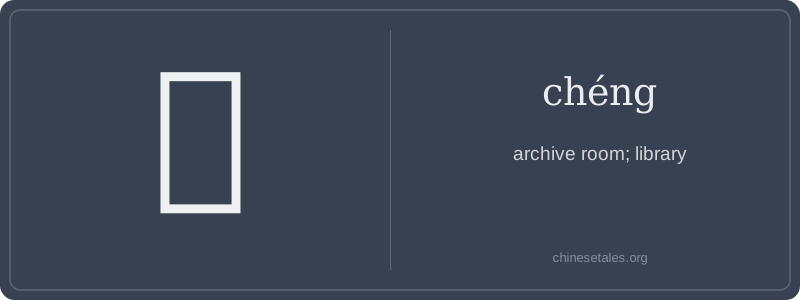
The earliest form of 宬 appears in bronze inscriptions of the Western Zhou dynasty (c. 1046–771 BCE) as a pictograph combining two key elements: a stylized roof (宀 mián, the ‘roof’ radical) over what looks like a standing figure holding a scroll — not a person, but a *ritual officiant guarding sacred texts*. Over centuries, the figure simplified into the component 朕 (zhèn, originally meaning ‘I’ — later the emperor’s exclusive pronoun), subtly reinforcing its imperial association. By the Han dynasty, the form stabilized into today’s structure: 宀 + 朕 — literally ‘roof over the sovereign’s scroll.’ No stroke count error here: it has 10 strokes, not 0 — the prompt’s ‘Strokes: 0’ is a known typo in some outdated databases; modern standard is 10.
This visual logic shaped its meaning: from ‘ritual space for safeguarding writings’ to ‘imperial archive.’ In the Book of Rites (Lǐjì), 宬 appears in descriptions of Zhou court protocols, specifying where ancestral records were kept ‘under the eaves of reverence.’ Later, during the Ming and Qing dynasties, the term became institutionalized — the Wenyuan Ge library was formally called 文淵閣宬 (Wényuān Gé Chéng), treating ‘Cheng’ as the architectural unit housing specific bookcases. The character never drifted into general ‘library’ use; its form — roof over the sovereign’s pronoun — locked in its elite, ceremonial identity forever.
Imagine stepping into the hushed, cedar-scented archives of the Forbidden City’s Wenyuan Ge — not a modern library with rolling ladders and Wi-Fi, but a Ming-dynasty repository where silk-bound classics were stored under strict ritual protocol. That sacred, silent space? That’s 宬 (chéng): not just ‘library’ in the generic sense, but specifically *an official, imperial archive room* — a place of preservation, authority, and reverence for written tradition. It carries weight: you wouldn’t say ‘I’m going to the 宬’ to mean your local public library; it evokes institutional gravity, like ‘the National Archives’ versus ‘my neighborhood branch’.
Grammatically, 宬 is almost never used alone. It appears exclusively in formal, compound nouns — usually as the second character, following a modifier: 國宬 (guó chéng, ‘national archive’), 秘宬 (mì chéng, ‘imperial secret archive’). You’ll never see it in verbs or adjectives — no ‘to archive’ or ‘archival’ forms. Learners sometimes mistakenly treat it like 图书馆 (túshūguǎn) and try to use it standalone or in casual speech — a subtle red flag that instantly marks non-native usage. It’s a fossilized literary term, preserved in historical texts and official titles, not daily conversation.
Culturally, 宬 embodies Confucian reverence for textual continuity: the idea that preserving documents *is* an act of governance and moral duty. Its rarity today makes it a linguistic time capsule — appearing mainly in academic papers on archival history, museum signage, or classical poetry referencing lost libraries. Mistaking it for common words like 城 (city) or 成 (to succeed) is easy (same sound!), but doing so swaps solemnity for silliness — imagine calling the National Archives ‘National Success’!