宧
Character Story & Explanation
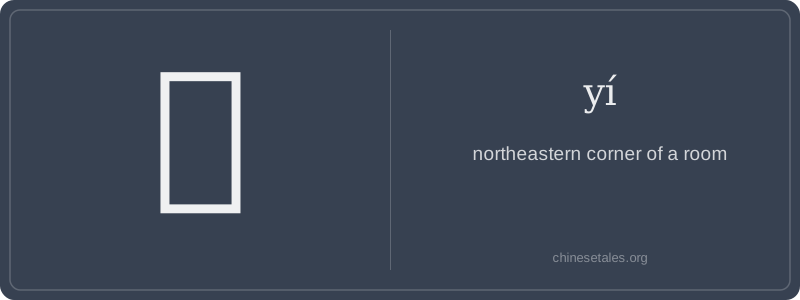
The earliest form of 宧 appears in late Western Zhou bronze inscriptions as a highly stylized pictograph: two parallel horizontal lines (representing floorboards or a raised platform) crossed by a short vertical stroke angled northeastward — like an arrow pointing up-right — all enclosed within a square frame symbolizing the room’s boundary. Over centuries, the ‘arrow’ simplified into the top-left stroke (丿), the floor lines fused into the horizontal strokes, and the enclosing frame evolved into the right-side component 丙 (bǐng), which originally depicted a ceremonial torch — reinforcing its ritual context.
By the Han dynasty, 宧 was codified in the Shuōwén Jiězì dictionary as ‘the northeast corner of a hall where ancestral rites are held’, citing its use in the Book of Rites. Its meaning never broadened — unlike 角 (‘corner’), which applies to any angle, 宧 remained tethered to ritual architecture. Even in Ming-Qing vernacular fiction, it appears only when describing ancestral halls or Daoist altars, always evoking solemnity and precision — not location, but *sacred orientation*.
Imagine you’re kneeling on a rush mat in a low-ceilinged Zhou dynasty hall, watching smoke curl from a bronze censer toward the rafters — and your teacher points silently to the far northeastern corner of the room, where ancestral tablets rest on a lacquered stand. That precise spot? That’s 宧 (yí). It doesn’t mean ‘corner’ in the generic sense like 角 (jiǎo); it’s a ritual *coordinate* — the sacred, fixed northeastern quadrant where qi gathers, spirits dwell, and offerings are placed. This isn’t geography; it’s cosmology made architectural.
Grammatically, 宧 is nearly extinct in spoken Mandarin — you’ll almost never hear it in conversation — but it lives on in classical texts, poetry, and temple inscriptions as a noun with zero inflection. It never takes measure words or modifiers like ‘this’ or ‘that’. You won’t say ‘this 宧’ — it’s always just 宧, like a proper noun. Learners sometimes misread it as a variant of 伊 (yī, ‘he/she’) due to similar sound, but 宧 has no pronoun function whatsoever — confusing them turns poetry into nonsense.
Culturally, 宧 reflects ancient Chinese spatial thinking: directions weren’t neutral — they carried moral and metaphysical weight. The northeast was associated with Gen ☶ (the Mountain trigram), stillness, beginnings, and ancestral veneration. Modern learners rarely encounter 宧 outside specialized study, but spotting it in a Tang poem or temple plaque instantly signals deep textual literacy — a quiet badge of classical fluency.