宦
Character Story & Explanation
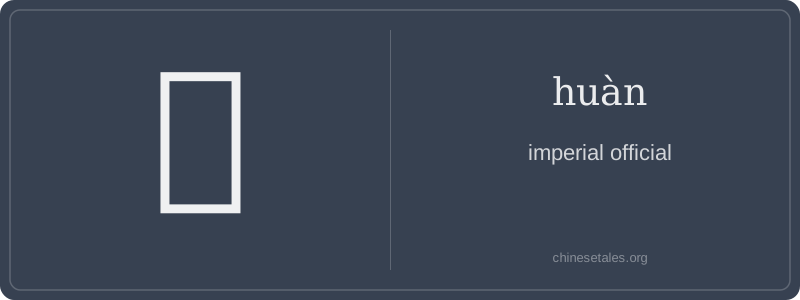
The earliest form of 宦 appears in bronze inscriptions (c. 11th–3rd century BCE) as a compound pictograph: a roof (宀) over a figure (often simplified later to 臣, ‘subject’ or ‘servant’). The original idea was strikingly literal — ‘a person under the imperial roof,’ i.e., serving within the palace walls. Over centuries, the lower component evolved from a kneeling servant glyph into 臣 (which itself means ‘subject’ or ‘minister’), while the roof radical 宀 remained stable — anchoring the sense of institutional enclosure and hierarchical shelter.
This visual logic shaped its semantic journey: from ‘one who serves under the palace roof’ → ‘imperial appointee’ → ‘court official’ → and eventually, by extension, ‘eunuch official’ (as many eunuchs held such roles). Confucius used 宦 critically in the Analects (14.20): ‘君子不为小人之役,不宦于小人之朝’ — ‘The noble person does not serve petty men, nor hold office in their courts.’ Here, 宦 isn’t neutral — it’s ethically charged, demanding integrity in service. Its shape — roof above subject — thus silently encodes the ancient Chinese ideal: authority granted only within a moral and structural framework.
At its heart, 宦 (huàn) isn’t just ‘official’ — it’s specifically an *imperial* official: someone appointed to serve the emperor in ancient China’s rigid bureaucratic hierarchy. Think less ‘civil servant’ and more ‘court insider’ — a role tied to power, privilege, and peril. The character carries quiet gravity; you’ll almost never hear it in modern speech or daily life (hence its absence from HSK), but it pulses with historical resonance in literature, history texts, and classical idioms.
Grammatically, 宦 functions primarily as a noun (‘an imperial official’) or, less commonly, as a verb meaning ‘to serve as an official at court’ — though this verbal use is archaic and literary. You won’t say ‘I am a 宦’ today; instead, you’ll encounter it in phrases like 宦官 (eunuch-officials) or in historical narratives: ‘He rose from poverty to become a high-ranking 宦.’ Note: it’s *not* used for modern government employees — that’s 官 (guān) or 公务员 (gōngwùyuán). Confusing 宦 with 官 is a classic learner trap — one evokes silk robes and palace corridors; the other, office buildings and ID cards.
Culturally, 宦 subtly implies proximity to power — and therefore vulnerability. In classical texts, 宦 often appears with moral weight: 宦海 (‘officialdom as a stormy sea’) warns of political turbulence, while 宦途 (‘the official’s path’) suggests a lifelong, high-stakes journey. Learners sometimes misread its radical 宀 (roof) as implying ‘home’ or ‘safety’ — quite the opposite! That roof shelters not comfort, but the watchful, hierarchical space of imperial administration.