宛
Character Story & Explanation
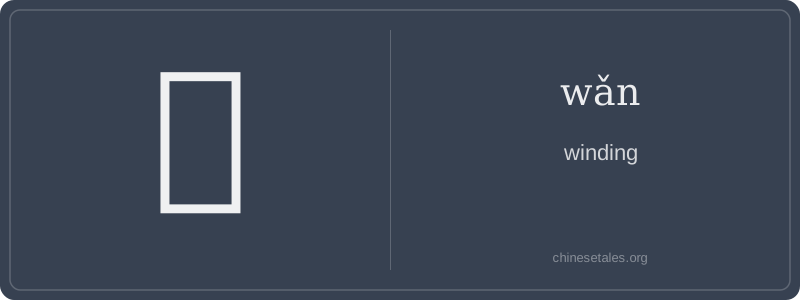
The earliest form of 宛 appears in bronze inscriptions as a composite glyph: on the left, a stylized depiction of a twisting serpent or coiled rope (the ancient precursor to the ‘夗’ component), and on the right, a roof-like cover (宀), suggesting containment or enclosure. Over time, the serpentine element simplified into 夗 — two curved strokes echoing a body in motion — while the roof radical 宀 remained steadfast at the top. By the Han dynasty, the structure had stabilized into today’s eight-stroke form: 宀 (roof) crowning 夗 (coiling), visually mirroring how a winding path is both sheltered by terrain and shaped by its own turning nature.
This duality — enclosure + curvature — anchored its semantic evolution. In the Shuōwén Jiězì (121 CE), Xu Shen defined 宛 as ‘qū yuán’ (curved and round), linking it to fluid movement. By the Tang era, poets like Wang Wei used 宛然 to evoke vivid, almost hallucinatory realism — ‘a scene so lifelike it seems to breathe’. The character’s visual rhythm — soft curves under a calm roof — became inseparable from its meaning: not forced bending, but organic, harmonious turning — the very essence of Daoist and literati aesthetics.
At its heart, 宛 (wǎn) evokes the quiet, graceful resistance of something bending but never breaking — think of a willow branch swaying in wind, a mountain road curling into mist, or even the subtle twist in a dancer’s wrist. It’s not just ‘winding’ as in a physical path; it’s the *feeling* of gentle, inevitable curvature — poetic, soft, and deeply visual. Unlike English adjectives that modify nouns directly, 宛 usually appears in literary or descriptive phrases, often before verbs like ‘appear’ (仿佛), ‘resemble’ (如), or ‘twist’ (转), lending a lyrical, almost cinematic quality.
Grammatically, it rarely stands alone: you’ll see it in structures like 宛若 (wǎn ruò, ‘as if’), 宛然 (wǎn rán, ‘just as though’), or in classical-style descriptions such as ‘山势宛延’ (shān shì wǎn yán, ‘the mountain’s contour winds gently’). Learners often misread it as a verb meaning ‘to wind’ — but 宛 is never used transitively like that; it’s always an adverbial modifier expressing resemblance or natural curvature. Don’t say ‘他宛了一条路’ — that’s nonsensical and ungrammatical!
Culturally, 宛 carries the hush of classical poetry and calligraphy — it’s the kind of character that appears in Tang dynasty landscape scrolls and Song dynasty essays on qi (vital energy), where winding lines symbolize harmony and flow. Its rarity in spoken Mandarin (hence its absence from HSK) means encountering it feels like spotting a rare bird: rewarding, but only if you’re reading literature, historical texts, or elegant prose. A common mistake? Skipping its tone — saying ‘wān’ instead of ‘wǎn’ — which risks confusion with 挽 (wǎn, ‘to pull back’) or 皖 (Wǎn, Anhui’s abbreviation).