宕
Character Story & Explanation
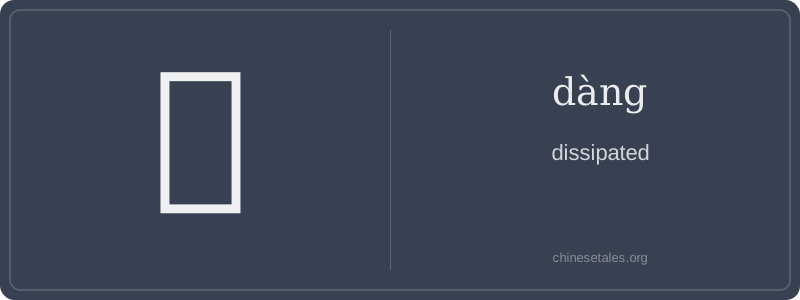
Carved in oracle bone script over 3,000 years ago, 宕 began as a vivid pictograph: a simple roof (宀) sheltering an open mouth (口) — but not for speaking. Scholars believe this depicted a *cave entrance* or *rocky hollow* — the mouth shape representing the yawning void beneath the overhanging cliff (the roof). Over centuries, the 'mouth' simplified into the squarish 口-like component we see today, while the roof radical 宀 remained firmly on top, anchoring the idea of a covered, recessed space — not a house, but an empty chamber carved into stone.
This spatial origin directly shaped its semantic evolution: from physical cavity → metaphorical emptiness → emotional or energetic depletion. In early texts like the *Zuo Zhuan*, 宕 appears in descriptions of 'vacant lands' or 'abandoned fortifications', where the emptiness implies strategic vulnerability. By the Tang dynasty, poets like Li Bai used 宕 in compounds like 往来宕荡 to evoke the unmoored, drifting spirit of wandering scholars — not restlessness, but a serene, echoing hollowness, like wind passing through an ancient grotto. Its visual stillness (no flowing water like in 荡, no fire like in 烫) mirrors its core idea: absence that resonates.
At first glance, 宕 (dàng) feels like a quiet, almost ghostly character — it’s rare in modern speech but pulses with classical weight. Its core meaning isn’t just 'dissipated' in the physical sense (like smoke vanishing), but evokes something more poetic: a lingering emptiness, a hollow space left behind after energy or presence has drained away — think of an abandoned courtyard at dusk, or a melody fading into silence. It carries a gentle melancholy, not chaos; it’s not 'destroyed' but 'unmoored', 'dispersed beyond recovery'.
Grammatically, 宕 is almost never used alone today — it’s a fossilized morpheme that lives only inside compound words (like 荡然, 往来宕荡). You’ll rarely see it as a verb or adjective by itself in contemporary writing; attempting to say *'tā dàng le'* ('he dissipated') would sound archaic or nonsensical to most native speakers. Instead, it appears in fixed literary phrases — often paired with 荡 (dàng) in reduplicative or alliterative forms (e.g., 宕荡) — where it reinforces rhythm and emotional resonance rather than literal semantics.
Culturally, learners often misread 宕 as a variant of 荡 (dàng, 'to swing, to roam') due to identical pronunciation and shared radical, but 宕 is far more static — it’s about *absence*, not motion. A common pitfall: mistaking 宕 for 汤 (tāng, 'soup') or 烫 (tàng, 'scalding') because of the 'ang' ending — but those have completely different radicals and tones. Also, note its tone: fourth tone (dàng), not first (dāng) like 当 — confusing them turns 'dissipated' into 'to be' or 'when'!