宓
Character Story & Explanation
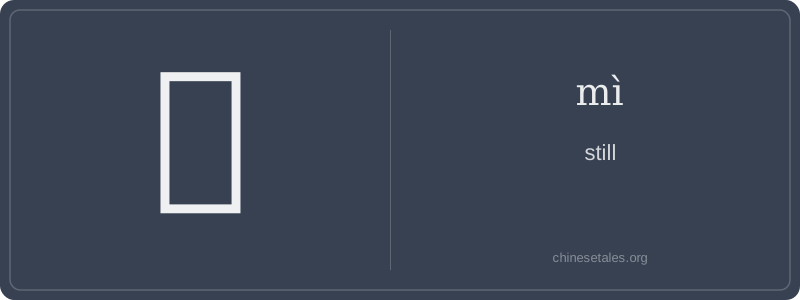
The earliest form of 宐 appears in bronze inscriptions (not oracle bones), where it was written with a roof radical (宀) over two horizontal strokes and a simplified 'mustard' or 'grain' component (冖 + 必, later stylized). Over centuries, the lower part evolved from 必 (bì, 'must') into the modern 必-like shape — but crucially, the original seal script emphasized containment under shelter: a person or essence held safely, motionlessly, beneath a roof. Every stroke reinforces enclosure and restraint — no exit, no disturbance, just profound interior stillness.
This visual logic shaped its semantic journey. In the Shuōwén Jiězì (121 CE), Xu Shen defined 宐 as 'quiet, unmoving' — linking it to the idea of being 'settled in place', like grain stored securely under a granary roof. Later, in Tang dynasty poetry, 宐 appears in phrases like '宓穆' (mì mù), describing the awe-inspiring calm of sacred mountains or ancestral halls. Its rarity today isn’t decline — it’s conservation: 宐 remains where stillness matters most — in reverence, in reflection, and in the quiet authority of classical Chinese.
At first glance, 宓 (mì) feels like a quiet whisper in the Chinese lexicon — it means 'still', 'calm', or 'silent', but not in the physical sense of 'not moving' (that’s 静 jìng). Instead, 宓 evokes a deep, inward stillness: the hush before dawn, the silence of a mountain lake at midnight, or the composed composure of a sage in meditation. It’s poetic, classical, and emotionally resonant — think of it as stillness with soul.
Grammatically, 宓 is almost never used alone in modern speech; it appears mainly in literary compounds or as part of names (especially historical or mythological ones, like Fú Xī’s wife Nü Wā — sometimes written with 宓 in older texts). You won’t find it in daily conversation, but you *will* see it in poetry, calligraphy inscriptions, or classical allusions. A common mistake? Trying to substitute it for 静 or 寂 — but 宓 carries no implication of loneliness (寂) or mere absence of noise (静); it’s about serene, unshaken inner equilibrium.
Culturally, 宓 is a linguistic fossil — preserved in elite literary tradition but virtually absent from spoken Mandarin and all HSK levels. Learners often stumble upon it in Tang poetry anthologies or Daoist texts, then wonder why their dictionary app shows 'rare' or 'archaic'. That’s the clue: this character isn’t broken — it’s resting. And like its meaning, it only reveals itself when you slow down enough to notice.