宋
Character Story & Explanation
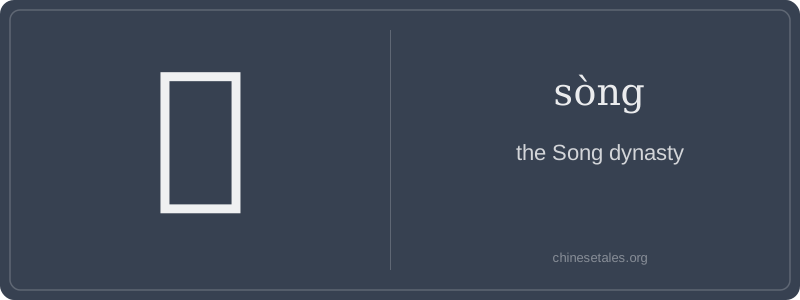
The earliest form of 宋 appears on Western Zhou bronze inscriptions as a compound pictograph: a roof radical (宀) sheltering a simplified depiction of a bell (冂 + 木-like base). This wasn’t a random combo — it represented the ancestral temple of the ancient State of Song (founded c. 1040 BCE), where ritual bronze bells were struck to honor the Shang dynasty’s royal lineage (Song was established by a Shang prince granted land by the Zhou). Over centuries, the bell element simplified: the top stroke became the horizontal line (一), the central vertical stabilized as 丨, and the lower strokes condensed into two diagonal strokes (丿 and 丶), yielding today’s clean 7-stroke form: 宀 + 木 (but note — it’s not actually the character 木! It’s a stylized remnant).
This visual origin explains why 宋 always carried weighty connotations of legitimacy and heritage. In the Analects, Confucius says of the Song people: 'Their rites are those of the Shang' — highlighting their role as cultural custodians. By the 10th century, when Zhao Kuangyin founded his new dynasty, he chose the name 宋 precisely to evoke this aura of classical virtue and continuity. The character’s roof (宀) literally shelters history — a subtle but powerful visual metaphor: the past isn’t buried; it’s housed, honored, and made foundational.
Think of 宋 (sòng) like the word 'Tudor' in English — it doesn’t mean 'king' or 'crown,' but the moment you hear it, you instantly picture a specific dynasty: rich blue-and-white porcelain, Su Shi’s poetry, Neo-Confucian scholars debating under willow trees, and the world’s first paper money. In Chinese, 宋 is almost exclusively a proper noun — it names the Song dynasty (960–1279 CE), one of China’s most culturally luminous eras. Unlike common nouns that flex across parts of speech, 宋 rarely stands alone; it’s nearly always part of a compound (e.g., 宋朝, 宋代, 宋瓷) and never used as a verb or adjective.
Grammatically, 宋 behaves like a historical brand name: it modifies nouns but never takes aspect particles (了, 过) or aspectual suffixes. You’ll never say *宋了* or *宋过* — that’s as ungrammatical as saying *'Tudored'* in English. Learners sometimes mistakenly treat 宋 as a generic word for 'song' (confusing it with the homophone 诵 sòng meaning 'to recite') or try to use it as a verb ('to Song'). But no — it’s a frozen cultural landmark, not a living action word.
Culturally, 宋 evokes precision, refinement, and quiet sophistication — think ink-wash landscapes rather than Tang-era gold-laden splendor. A common mistake is overgeneralizing its use: while 宋 can appear in modern surnames (e.g., 宋先生), it’s never used in casual conversation without historical or familial context. And crucially: it’s not related to the English word 'song' — that’s pure coincidence (the English word comes from Germanic *sangwiz*, while 宋’s pronunciation evolved from Old Chinese */sruŋ/).