宄
Character Story & Explanation
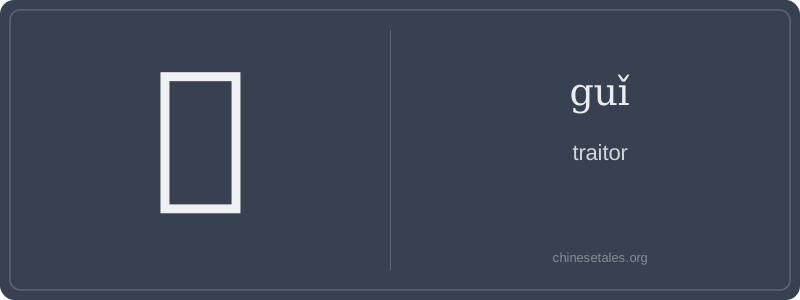
The earliest form of 宄 appears in late Shang oracle bone inscriptions as a simple yet potent composition: a roof-like shape (宀) above a bent human figure (pronounced *guǐ*, possibly mimicking a crouching, furtive posture). By the Western Zhou bronze script, the lower element evolved into a stylized ‘person’ with arms folded inward—a visual metaphor for concealed intent under shelter. Over centuries, strokes simplified: the person became the three-stroke 九 (jiǔ) shape we see today—not the number nine, but a phonetic and semantic echo of ‘coiled, hidden movement’. Crucially, the roof (宀) never changed—it anchored the meaning: betrayal *under the same roof*.
This spatial logic shaped its entire semantic history. In the *Zuo Zhuan*, 宄 appears in condemnations of ministers who conspired against their lords ‘within the ancestral temple’—the ultimate violation of 宀’s sanctity. Unlike generic words for ‘enemy’, 宄 always implied proximity, trust, and therefore deeper moral injury. Even in Tang poetry, when poets wrote of ‘the 宄 who stole the jade seal’, the roof radical reminded readers: this wasn’t invasion from without—it was the steward unlocking the door from inside.
Imagine a tense imperial court scene: a trusted minister bows low before the emperor—then slips a forged edict into the sleeve of his robe. The moment he turns, the character 宄 flashes in the historian’s scroll like a crimson warning. This isn’t just ‘traitor’—it’s *treachery from within the roof*, a betrayal that violates the sacred shelter of loyalty itself. In classical and literary Chinese, 宄 carries visceral moral weight: it implies deliberate, intimate deception by someone who *should* be safe—like family, ministers, or disciples. You’ll almost never hear it in casual speech today; it’s reserved for historical narratives, political essays, or solemn condemnations.
Grammatically, 宄 functions almost exclusively as a noun (‘a traitor’) or occasionally as a verb in archaic constructions (‘to betray’), but only in highly stylized contexts—never as an adjective (*not* ‘traitorous’). Learners often mistakenly try to use it like 叛徒 (bàntú), which *is* modern and neutral—but 宄 is charged, poetic, and nearly always appears with classical particles like 之 (zhī) or in four-character idioms. Using it in daily conversation would sound like quoting Confucius at a coffee shop: technically correct, hilariously out of place.
Culturally, 宄 evokes the Confucian horror of *disrupting the roof*—the 宀 radical symbolizing the familial or institutional shelter that the traitor has shattered from within. A common mistake is overgeneralizing its meaning: it doesn’t mean ‘spy’ or ‘enemy agent’ (that’s 间谍 jiàndié); it specifically denotes *insider betrayal*. Also, don’t confuse it with homophones like 轨 (guǐ, ‘rail/track’) or 圭 (guī, ‘jade tablet’)—their meanings are utterly unrelated, and mixing them up could turn your essay on Zhou dynasty politics into a train timetable.