宀
Character Story & Explanation
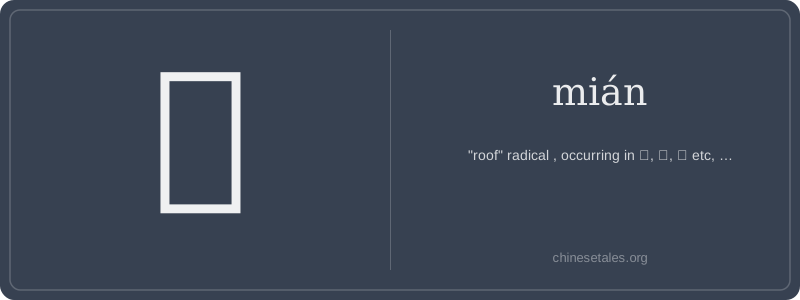
The earliest form of 宀 appears in oracle bone inscriptions (c. 1200 BCE) as a bold, sweeping arch — a stylized outline of a thatched roof seen from the front, with two sloping eaves curving down from a central ridgepole. Over centuries, the curves softened, the ridge shrank into a short horizontal stroke, and the eaves became two smooth, descending strokes — arriving at today’s three-stroke form: 丶 (dot), (left-falling curve), and 乛 (right-falling curve). No sharp angles, no rigid lines — just the quiet, embracing arc of shelter.
This visual gentleness mirrors its semantic evolution: from literal roof → enclosure → protection → domestic tranquility. In the *Analects*, Confucius says '君子务本,本立而道生' ('The noble person attends to the root; with the root established, the Way arises') — and for classical thinkers, that root was often the 宀-covered home, the first site of moral cultivation. Even today, when you see 宀 atop 安 (ān, 'safe') or 富 (fù, 'wealthy'), you’re seeing 3,000 years of cultural architecture — a roof not just over heads, but over values.
Think of 宀 (mián) as the 'roof tile' of Chinese characters — not a standalone word you’ll use in conversation, but the architectural blueprint hiding above dozens of everyday terms. Like the Greek root 'geo-' (earth) in geography or geology, 宀 is a silent semantic anchor: it doesn’t carry sound or stand alone, but signals 'shelter', 'enclosure', or 'domestic space'. You’ll never say 'mián' aloud in isolation — unless you’re naming the radical itself — but you’ll see it presiding over words like 家 (jiā, 'home'), 安 (ān, 'safe'), and 定 (dìng, 'to settle').
Grammatically, 宀 functions *only* as a radical — a meaning-bearing component tucked into the top of characters. It’s never a verb, noun, or particle. Learners sometimes mistakenly treat it like a character they can use independently (e.g., writing 宀 alone to mean 'roof'), but that’s like writing the letter 't' and expecting it to mean 'top' in English. Its power lies entirely in context: when combined with 豕 (shǐ, 'pig') in 家, it transforms the meaning from 'pig under a roof' → 'family home' — a vivid ancient snapshot of domestic life.
Culturally, 宀 carries quiet weight: it evokes the Confucian ideal of the protected, harmonious household — the moral and physical foundation of society. A common slip is confusing it with 冖 (mì, 'cover' radical), which is flatter and lacks the gentle downward curve. And while native speakers call it bǎo gài ('treasure cover') in teaching contexts — referencing its resemblance to an ornate canopy over precious things — this is purely pedagogical; it has no relation to 'treasure' (宝) semantically.